Culture
The Boulangerie and the Drive-Thru
In France, the morning bread run is a pilgrimage performed on foot, sometimes twice a day; in America, the morning food run happens at speed with the engine idling. Both are about the first meal of the day — they just disagree about whether it should require leaving the car.
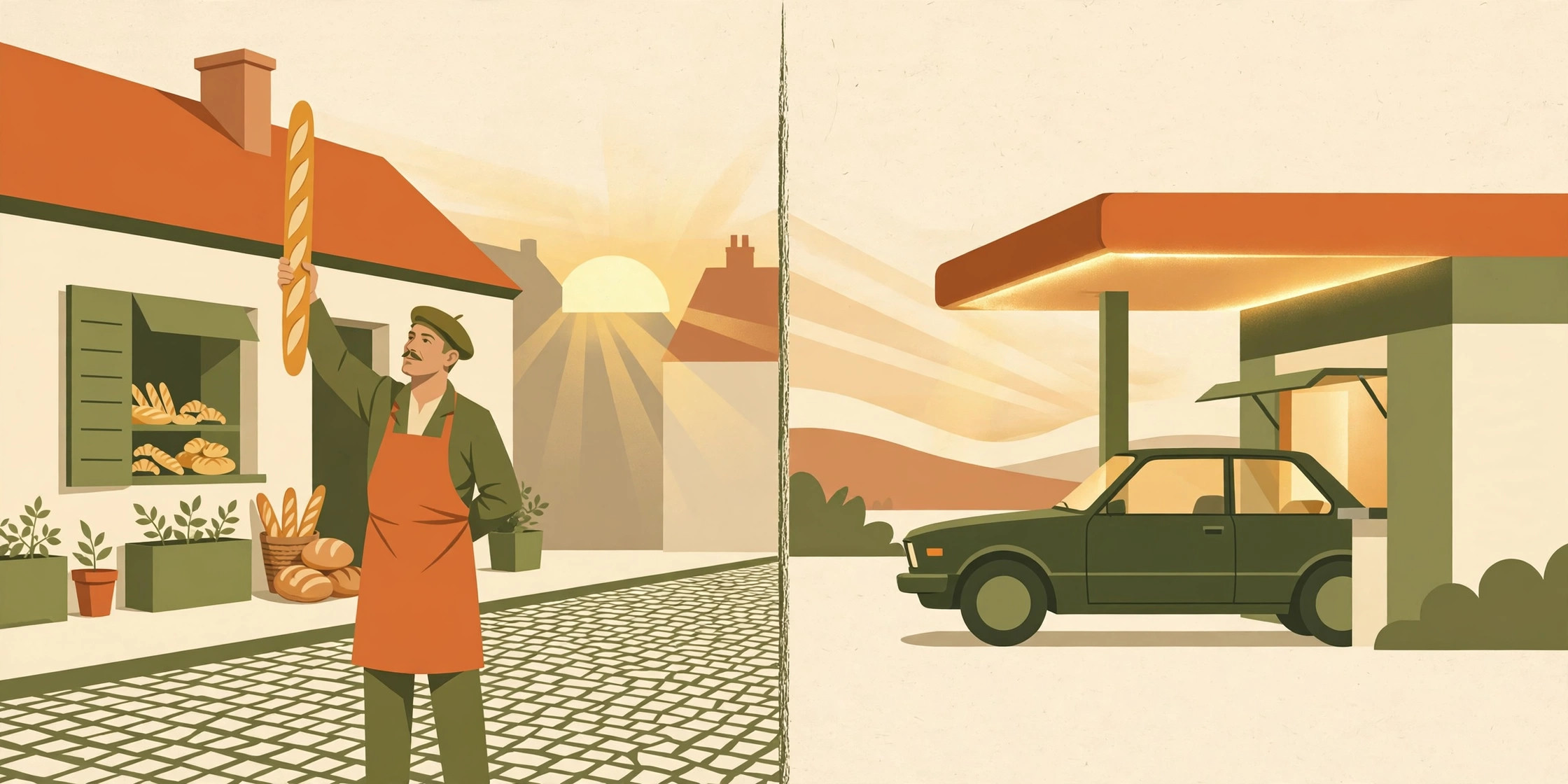
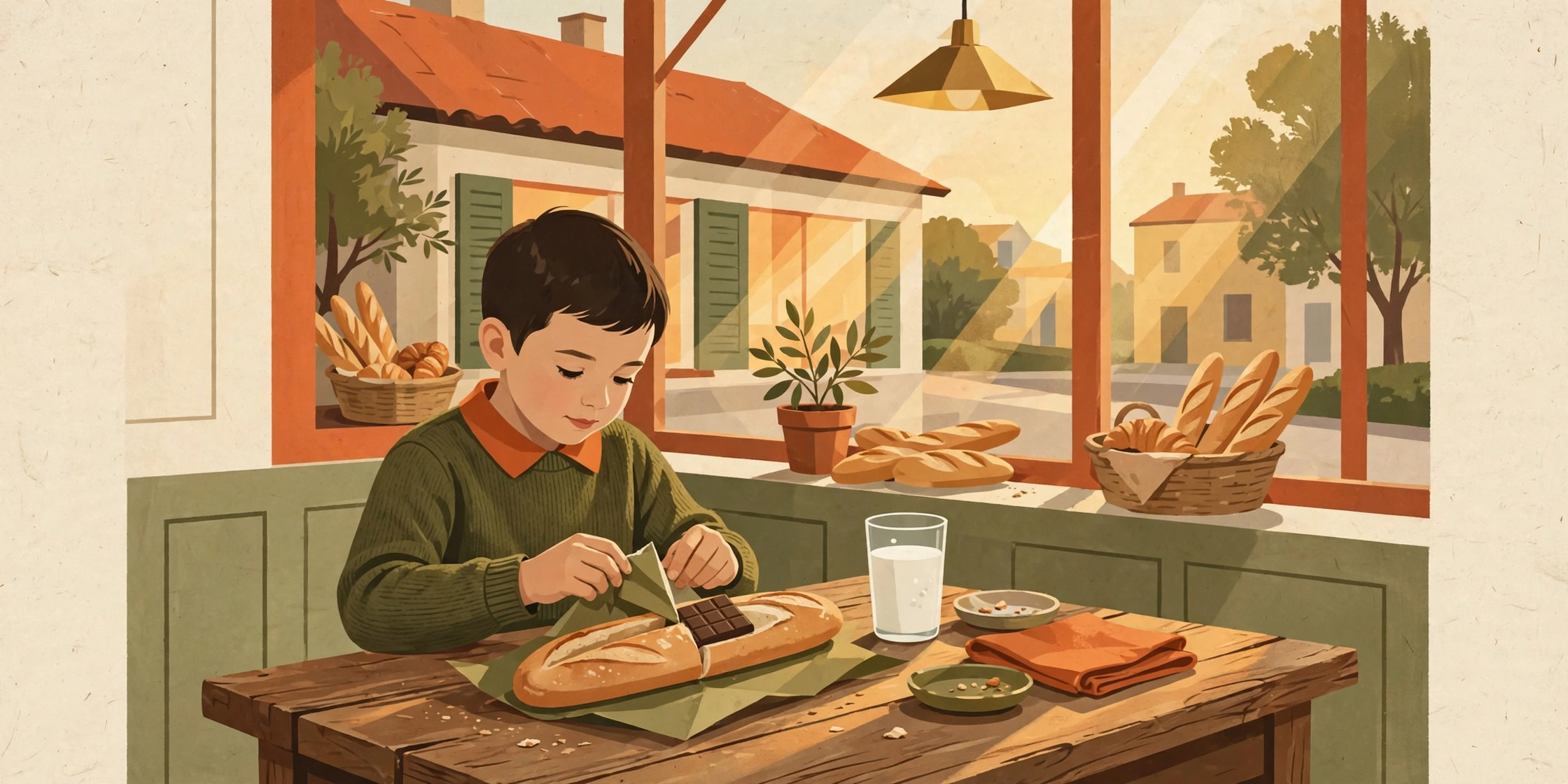
Every morning in France, at roughly the same hour, a quiet migration begins. People leave their homes with a purpose that looks like no purpose at all: they walk to the boulangerie. They buy a baguette — warm, still sighing from the oven — and they walk home carrying it the way a herald carries a staff: upright, visible, slightly ostentatious. If the walk is longer than ten minutes, the end of the baguette will not survive the journey. This is not a failure of discipline. It is the tithe. Everyone nibbles the crust on the way home. Everyone. The French have simply decided, as a civilization, not to discuss it.
The American morning migration moves at forty miles an hour and never stops. From the driver’s seat, a voice gives the order — the big one, the number three, extra hash browns — and a window slides open, a bag slides in, and the car rejoins traffic before the bag is even fully inside. The entire transaction takes less time than the French walk to the bakery takes to become worth it. The American has not gone to get food so much as food has intercepted the American mid-route, the way a relay runner takes the baton without breaking stride.
Advertisement
These are both breakfasts. That is the only thing they agree about.
The pilgrimage
The boulangerie run is, technically, an errand, but the French have arranged it so that it functions as everything except an errand. It is a walk. It is fresh air before the day begins. It is the moment the village, the street, the neighborhood confirms that it still exists — because the line at the bakery is a small daily parliament, and the people in it are your constituents whether you elected them or not. You see the same faces. You exchange the same four sentences. Nobody is in a hurry, and this is the part the American mind finds genuinely difficult to process: nobody is in a hurry on purpose.
The baguette itself is a perishable philosophy. A true baguette has a lifespan measured in hours, not days — crisp at eight in the morning, nostalgic by noon, a weapon by evening. This is why the French go twice. The second trip, for the evening bread, is so culturally non-negotiable that bakeries plan their entire production around it. The French have built a food whose defining feature is that it does not last, and then built a daily life around the fetching of it. If that is not a statement of values, nothing is.
And then there is the law — yes, there is a law, of course there is a law, this is France. Since the early nineties, a baguette calling itself tradition française must be made on the premises, never frozen, from a short list of ingredients that reads like a haiku: flour, water, salt, yeast. The French did not merely love their bread; they legislated its soul. An American hearing this for the first time usually laughs, and the French person telling it does not laugh at all, which tells you everything about both parties.
The interception
The drive-thru is, technically, also an errand, but the Americans have arranged it so that it functions as a refutation of errands. Why go to food when food can come to you, at the window, while the podcast plays and the air conditioning hums? The drive-thru is the logical endpoint of a civilization that decided long ago that time spent not moving is time lost. It is not laziness. It is efficiency wearing a paper hat.
And you have to respect the engineering. The drive-thru window is a small miracle of logistics: a national network of kitchens synchronized so that a bag of hot food can be handed to a moving vehicle in under two minutes, millions of times a day, in every state, at every hour. The French queue for bread once a day and call it civilization. The Americans never queue at all and call it freedom. Both are describing the same thing — the dignity of not being made to wait — and neither will ever admit it.
Advertisement
The food itself tells the story in miniature. The baguette is one ingredient doing one thing perfectly, and it dies within hours. The drive-thru bag is a dozen ingredients doing a dozen things adequately, and it survives the commute. The French breakfast is fragile and demands your presence. The American breakfast is durable and demands nothing. You could argue this is the whole transatlantic disagreement in a paper sack.
There is a small, telling detail in each ritual that gives the game away. The French detail is the tithe — the nibbled end of the baguette, eaten on the walk home, in public, by everyone, with total unselfconsciousness. The American detail is the french fry eaten in the car between the window and the first red light — also in public, also by everyone, also with total unselfconsciousness. Both civilizations have a sacred pre-meal snack. The French one requires legs. The American one requires wheels.
The geography of appetite
Here is the uncomfortable truth neither side likes to say out loud: each ritual is perfectly adapted to its landscape, and each would collapse in the other’s. The boulangerie run works because the bakery is five minutes away on foot, because the street is walkable, because the village or the arrondissement was designed for human legs. Put that bakery twenty miles down a six-lane highway and the pilgrimage becomes a pilgrimage of the damned. The drive-thru works because the distances are vast, the car is a second home, and the morning commute is forty minutes of unclaimed time that something might as well fill. Drop that drive-thru into a medieval street in the Dordogne and it would sit there like a spaceship in a vineyard.
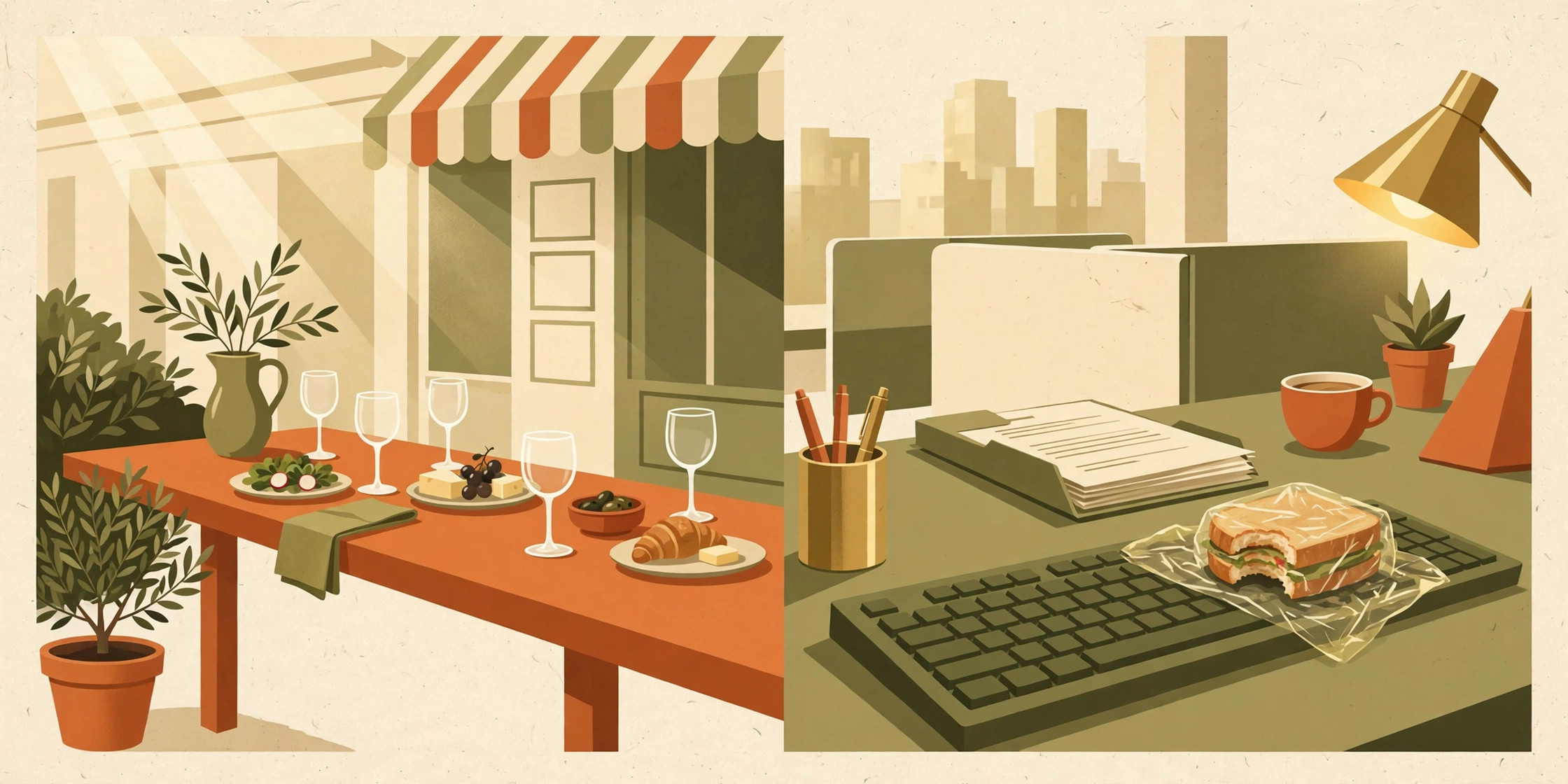
So the argument is not really about bread versus breakfast sandwiches. It is about what a morning is for. The French morning has a hole in it shaped like a walk, and the walk is the point. The American morning has no hole in it at all, and the absence of the hole is the point. The French will tell you that a day begun without fresh air is a day begun wrong. The American will tell you that a day begun with forty wasted minutes is a day begun wrong. Both are right. Both are talking about the same forty minutes.
The French walk to their breakfast because the walk is the breakfast. The Americans drive through theirs because the day has already started.
It is worth noting, for fairness, that both countries are drifting toward each other and would rather die than admit it. French cities now have drive-thrus on their outskirts — the golden arches glowing at the edge of the medieval town like a visiting dignitary who will not leave — and the French use them, guiltily, at midnight, telling no one. American cities, meanwhile, have discovered the farmers’ market, the artisanal bakery, the forty-dollar sourdough, and the Saturday-morning line of people waiting, on foot, for bread. The line moves slowly. Nobody minds. Somewhere in Brooklyn a woman is nibbling the end of a baguette on her walk home, and she has no idea she is performing a French sacrament. The French would recognize her instantly. They would not discuss it.
What the rituals are really saying
Strip away the flour and the exhaust fumes and each ritual is making the same claim: we know how to live. The boulangerie run says that life is measured in small, repeated pleasures, and that convenience is a poor substitute for ceremony. The drive-thru says that life is measured in momentum, and that ceremony is a poor substitute for getting on with it. The French suspicion is that the Americans have mistaken speed for freedom. The American suspicion is that the French have mistaken routine for meaning. The suspicion is, in both cases, half right, which is why the argument never ends.
There is a pétanque lesson buried in here, if you want it. The boulangerie run is a pointer’s errand: slow, precise, placed exactly where it should be, twice a day, every day, until the terrain itself remembers. The drive-thru is a tireur’s errand: fast, decisive, aimed at the whole problem at once. The pointer accumulates the morning, boule by boule. The shooter clears it in one throw. France points its breakfast. America shoots its breakfast. And the cochonnet — the small, still thing everyone is actually playing toward — is the same on both terrains: a morning that feels, for a minute, like it belongs to you.