Glossary
Doublette
Two against two, three boules each — the most-played format in pétanque, and a small theory of friendship in three configurations.
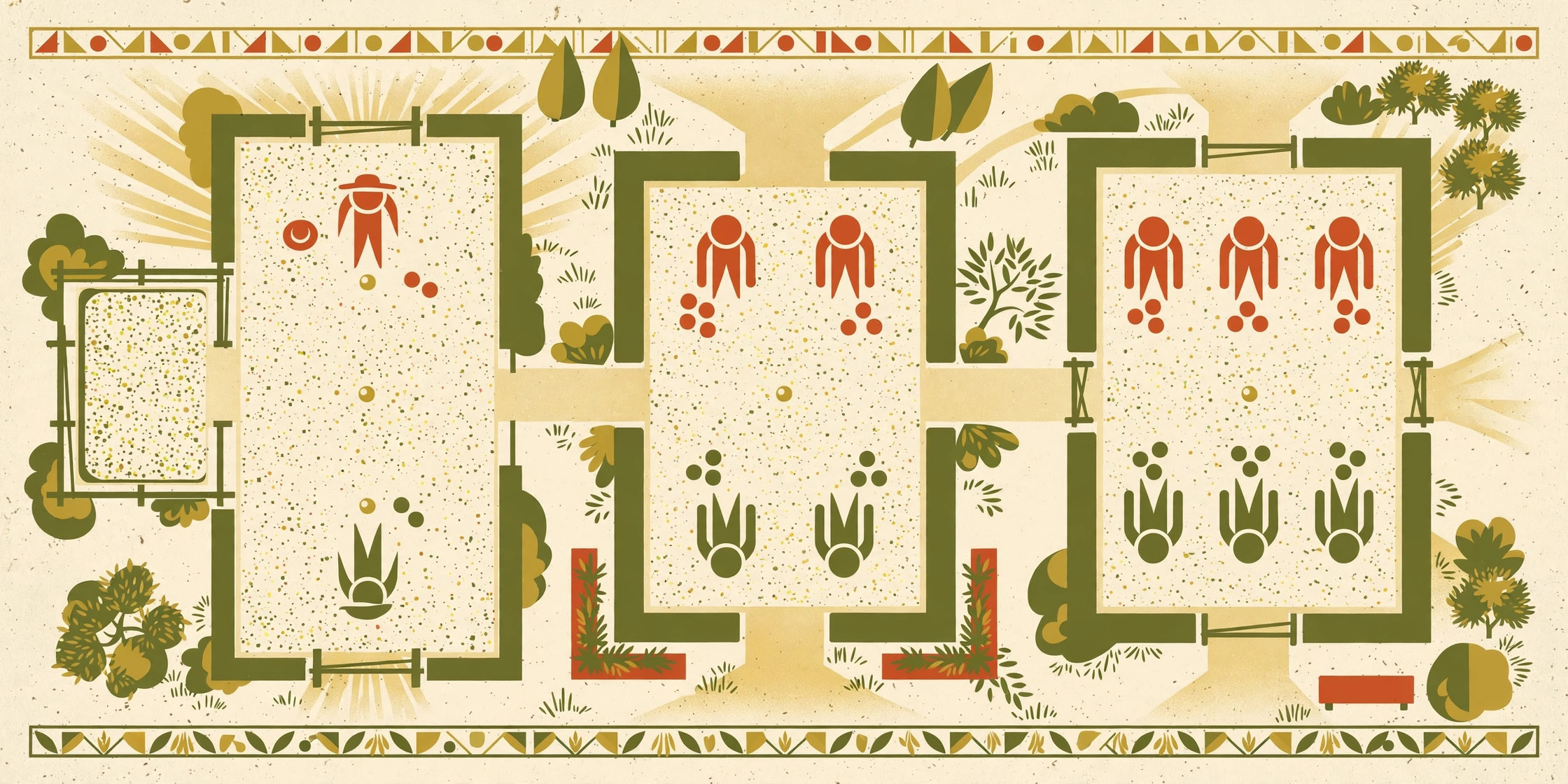
Doublette (n.f.) — a team of two players against another team of two, each player holding three boules. The format of the village square, the Sunday afternoon, and roughly every casual game ever played. Also, incidentally, a perfect laboratory for studying human relationships.
Pétanque comes in three official sizes, and each one is a different sport wearing the same clothes. Learn the three, and you learn not just a game but three ways of being with other people.
Advertisement
The mathematics are simple enough for a child and subtle enough for a lifetime. Tête-à-tête: one against one, three boules each. Doublette: two against two, three boules each — six boules per side, the richest hand in the game. Triplette: three against three, two boules each — the official format of championships, and the noisiest.
The duel
Start with the tête-à-tête, because it is the purest and the loneliest. One player, three boules, the whole terrain, the whole silence. There is no partner to consult, no one to blame, no one to forgive. Every decision is yours: the line you choose, the risk you take, the carreau you attempt and miss.
It is the format of the purist and the masochist, and they are often the same person. Village wisdom holds that you cannot hide in a tête-à-tête — your weaknesses arrive at the terrain before you do, settle into the gravel, and wait. The French have a tender phrase for losing one: se faire prendre en tête-à-tête, to be taken one-on-one, which sounds almost romantic until it happens to you.
Conversation in a tête-à-tête is minimal and formal, like a duel at dawn conducted by people who will share an apéro afterward. You greet, you play, you measure. The talking happens mostly inside your own head, and it is rarely kind. This is pétanque as chess: total responsibility, total exposure, and the strange exhilaration of having only yourself to congratulate.
Americans, raised on the romance of the solo competitor — the pitcher, the quarterback in the pocket, the golfer alone with the course — often assume the tête-à-tête is the serious format and the others are its social dilution. The French see it almost inversely: the duel is respected, but it is a little ascetic, a little monastic. A man who only plays tête-à-tête is admired the way a hermit is admired — from a respectful distance, with no desire to join him.
The pair
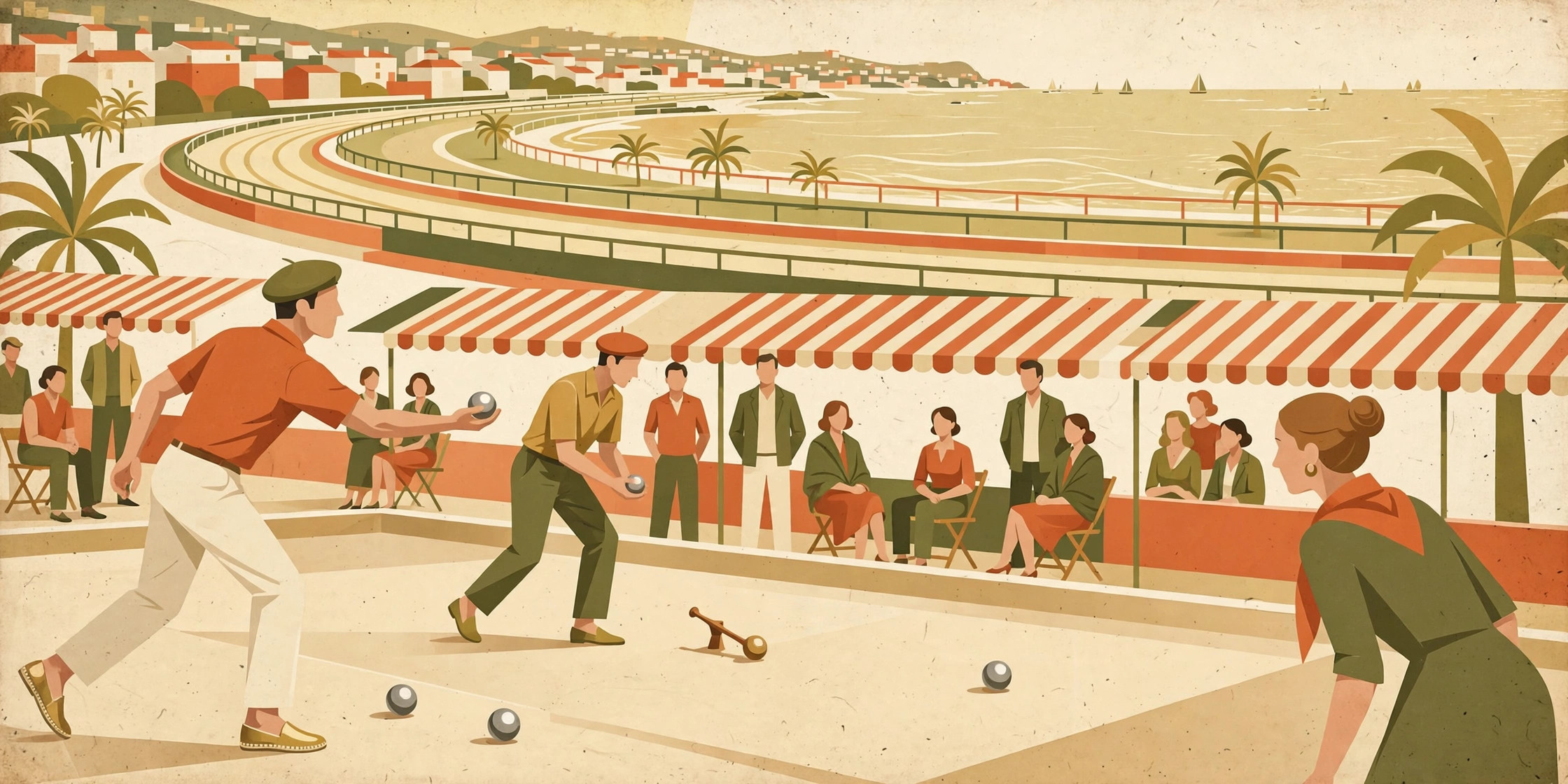
Then the doublette, and everything softens and complicates. Two against two, three boules each — which means each side still has six boules, the same full hand as the tête-à-tête, but now distributed across two minds and two temperaments. This is the format everyone actually plays, the default setting of the game, the one your grandfather means when he says on fait une partie.
The doublette invents roles the way a marriage invents chores. In theory both players do everything; in practice, one becomes the pointeur, the careful one who places boules near the cochonnet, and the other becomes the tireur, the bold one who knocks the opponent’s boules away. Nobody assigns these roles. They emerge, like weeds or like love, from whatever each person is already like.
A doublette is a friendship with a scoreboard: it will tell you, kindly or not, who you really are together.
Here is the social genius of the format: three boules each is enough to matter and few enough to need your partner. You cannot carry the game alone, and you cannot disappear from it either. Every mène requires a small negotiation — tu pointes, je tire? — conducted in glances, shrugs, and the occasional theatrical sigh. The doublette is a conversation that happens to include throwing steel balls.
Partnerships in doublette develop the permanence of marriages. In villages across the south of France, the same two men have played together every Sunday for thirty years, and the terrain knows their routines the way a kitchen knows a couple’s. They finish each other’s sentences and each other’s mènes. American visitors sometimes mistake this for mere habit; it is actually the highest form of the game, a duet rehearsed over decades.
Couples play doublette, which is either the best or the worst idea depending on the couple. There is no neutral ground: a mixed doublette either becomes the tenderest hour of the week or a public seminar on blame. The wise partners learn the golden rule early — you may criticize the throw, never the thrower — and the wise couples were already living by it.
Then there is the pure arithmetic pleasure of the doublette’s twelve boules. With six boules per side, the ends can build into small epics: leads overturned, cochonnet displaced and rechased, a final boule thrown with everything riding on it. The triplette has the same twelve boules, but split six ways they scatter like conversation at a large table; in the doublette, twelve boules in four hands means every single throw carries the weight of a quarter of your team’s ammunition. Nothing in pétanque concentrates the mind like watching your partner step into the circle holding your last hope.
Advertisement
The crowd
Add one more player per side and the game transforms again. Triplette: three against three, two boules each. Six players, twelve boules, and suddenly the terrain sounds like a restaurant. This is the format of championships, of clubs, of the great televised finals — and it is a fundamentally different social animal.
Two boules each changes the arithmetic of courage. With three boules, a player can afford a mistake and a recovery; with two, every throw is load-bearing. Specialization becomes mandatory rather than organic: the pointeur points, the milieu — the middle player, the game’s most underrated role — does a bit of everything, and the tireur arrives at the end like artillery. Nobody chooses to be the milieu; the milieu is what happens to the most generous player.
Conversation in a triplette is constant, overlapping, and half the pleasure. Three people must agree on a strategy every mène, which means three opinions, two compromises, and one person who was right but graciously lets it go. The French term for a team talk is la concertation, a word that also describes cabinet meetings, and the comparison is not entirely unfair. Some triplettes play pétanque; others hold a small parliament that occasionally throws boules.
This is also where the famous slowness of championship pétanque comes from — six players measuring, conferring, measuring again, while the crowd holds its pastis and its breath. Purists complain; sociologists take notes. The triplette is the least efficient and the most communal of the three formats, and that is precisely the point.
Spectators, too, vote with their feet, and they vote triplette. The great finals that fill village squares and television screens are always three-against-three, because six players generate the plot twists: the surprise substitution of roles mid-game, the milieu who suddenly shoots like a champion, the collective groan when a team’s last boule dribbles short. A tête-à-tête is fascinating to play and austere to watch; a triplette is theater, complete with a cast, an audience, and intermissions for measuring.
The geometry of company
Step back and the three formats form a tidy theory of togetherness. The tête-à-tête is a monologue: you, the boules, the truth. The doublette is a dialogue: you, one other person, and the delicate machinery of agreement. The triplette is a dinner party: lively, slightly chaotic, and memorable in proportion to its disorder.
The Americans discovering pétanque tend to love the doublette instantly, and it is easy to see why. It has the relaxed sociability of a backyard barbecue with just enough structure to feel like a real contest. Two-on-two is the native format of American leisure — think doubles tennis, beach volleyball, cornhole with a partner — and the doublette slots into that tradition like it was always there.
The French, meanwhile, treat the choice of format as a statement of intent. A tête-à-tête says: I want to know exactly how good I am. A doublette says: I want to spend the afternoon with you. A triplette says: the more the merrier, and bring the chairs. The format is the invitation; the game is what happens after everyone accepts.
There is also a quiet etiquette of numbers that visitors absorb slowly. You do not propose a tête-à-tête to a stranger — it is too intimate, too revealing, like suggesting you skip the small talk and discuss your childhoods. You do not assemble a triplette without checking that everyone actually wants the afternoon to last that long. The doublette is the safe harbor: easy to propose, easy to join, easy to leave with everyone still friends.
Even the apéro afterward obeys the geometry. Lose a tête-à-tête and honor demands you buy the round — one drink, one debt, cleanly settled. A doublette splits everything down the middle, including the stories, which is why doublette partners develop a shared mythology at twice the normal speed. A triplette ends with six people at the table, six versions of the decisive mène, and nobody going home before the third telling. The game ends at thirteen points; the evening, mercifully, has no such limit.
Choosing your number
So which format is the real pétanque? The federation would say triplette — it is the championship format, the one with the trophies and the television. The villages would say doublette — it is the format of daily life, of the square at six o’clock, of the game played ten thousand times for nothing but the pleasure of it. The philosophers would say tête-à-tête, because it strips the game to its essence: one human, three chances, no excuses.
They are all right, which is the most French possible answer. The three formats are not rivals but seasons — the duel for testing yourself, the pair for knowing someone, the crowd for belonging somewhere. A complete player moves between them the way a complete life moves between solitude, friendship, and community.
Ask a player which format they prefer and listen carefully, because they are telling you something about themselves. The tête-à-tête player trusts no one’s judgment but their own. The doublette player has found their person and sees no reason to play with anyone else. The triplette player believes, against mounting evidence, that six people can agree on anything — and loves them for trying.
The boules are the same. The cochonnet is the same. Only the number of hands changes — and with it, everything.