Glossary
Terroir
The great untranslatable French word: soil, climate, and know-how — and why it has no English equivalent.
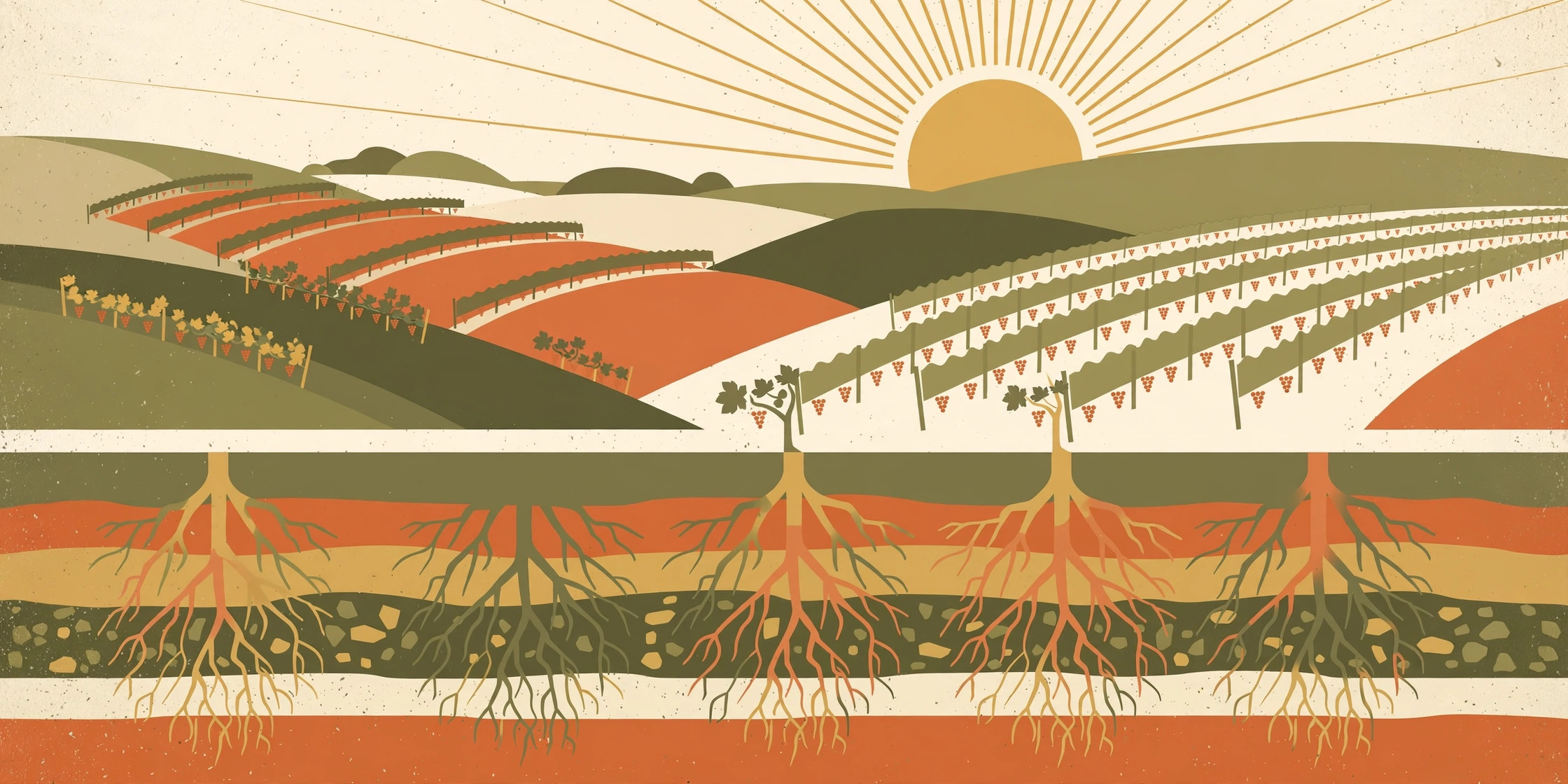
There is no English word for terroir, and that absence is the whole story. You can explain it — soil, climate, the know-how of the people who work the land, the taste of a place — but explanation is not translation. Translation gives you the same thing in another language. Terroir refuses. It sits there, untranslatable, like a stone in the field that every plow in America has tried to move.
Small wonder the word gets abused in English. Walk through an American specialty store and you will find terroir on chocolate bars, on whiskey bottles, on bags of coffee — deployed the way artisanal was deployed a decade ago, as a premium-sounding way of saying expensive. None of these products are lying, exactly. They are doing what English always does with French words it cannot translate: turning a worldview into a vibe. Terroir-driven sounds better than single-origin, and it costs the marketing department nothing. The French watch this the way a watchmaker watches someone use a chronometer as a paperweight.
Advertisement
The word itself is almost aggressively plain. It comes from the Latin territorium, land, territory. In French it simply meant the soil of a region, the dirt under your boots. Peasants said ça sent le terroir — it smells of the soil — the way you might say a stew tastes of the farm. It was not a philosophy. It was a fact about mud.
Then the French did what the French do: they took a peasant word and built a civilization on it. By the early twentieth century, terroir had become the organizing principle of French food and wine — the idea that a product carries the signature of the exact patch of earth it came from, and that this signature cannot be reproduced anywhere else. A Roquefort is not a blue cheese that happens to be made in Roquefort. A Roquefort is Roquefort: the limestone caves, the raw sheep’s milk of the Larzac plateau, the mold that lives in those caves and nowhere else. Move any part of the equation and you do not get Roquefort made elsewhere. You get something else entirely, and the French will tell you so, at length.
This is why English has no equivalent. English is the language of the movable and the scalable. An American food word succeeds when it can travel: hamburger, barbecue, brunch. The ideal American product is the same in Ohio and Oregon. Terroir is the opposite ideal. It says: this thing can only exist here. It is a theory of value based on irreproducibility — which, in the American commercial imagination, sounds less like a selling point than a manufacturing defect.
The French did not merely believe in terroir. They legislated it. In 1935, France created the appellation d’origine contrôlée — the AOC — a legal system that ties a product’s name to its place of origin and to the traditional methods used there. Champagne can only come from Champagne. Camembert de Normandie can only come from Normandy, from Norman cows, made the Norman way. The law does not protect a recipe; it protects a relationship between a people and a place. Later the system expanded across Europe as the AOP, but the logic stayed French: the name is the place, the place is the name, and faking either one is not clever marketing but fraud.
It is worth pausing on how strange this is as a legal concept. Most law protects things you can own: property, patents, trademarks. The AOC protects something nobody can own — a collective, centuries-long conversation between farmers and soil. No single winemaker invented the taste of Burgundy. Thousands of anonymous Burgundians did, one vintage at a time, over a thousand years. The law’s answer to the question “who owns this?” is, essentially, everyone who belongs here, and no one else.
Nowhere is the logic pushed further than in Burgundy, where terroir becomes almost cartographic. The region’s vineyards are divided into climats — hundreds of precisely delimited, individually named parcels, some no wider than a few rows of vines, each with its own documented history, character, and price. Two climats can sit side by side on the same slope, share the same grape and the same winemaker, and produce wines the locals insist taste of different earths. In 2015, UNESCO listed the Climats of Burgundy as a World Heritage site — the first time the United Nations had effectively declared that dirt, carefully attended to, is culture. The French were delighted. Everyone else did the math on what a few rows of vines were worth and felt slightly dizzy.
Americans, confronted with terroir, did the most American thing possible: they tried to buy the effect without the cause. Napa Valley is the great case study. California winemakers in the 1960s and 70s looked at Bordeaux and Burgundy and asked the right question — why is this wine great? — and gave the American answer: better technology, better equipment, better marketing. And it worked, spectacularly. In 1976, at the famous blind tasting in Paris now called the Judgment of Paris, California wines beat the great Bordeaux and Burgundy houses. The French were horrified. The Americans were vindicated. The scoreboard said everything.
But here is the part the scoreboard missed. Napa did not beat Burgundy at terroir; it beat Burgundy at winemaking. The Californians proved that skill and technology could produce extraordinary wine. What they did not prove — what they could not prove — is that Napa tastes like Napa the way Burgundy tastes like Burgundy. Ask a Napa winemaker what makes their wine distinct and you will hear about clones, rootstocks, barrel programs, scores. Ask a Burgundian and you will hear about a slope. A specific slope. That slope, not the one next to it. The American answer is about what the winemaker does. The French answer is about where the winemaker stands.
Advertisement
To be fair, America has been inching toward the idea. The federal government created American Viticultural Areas — AVAs — in the late 1970s, geographic designations for wine regions that look, at first glance, like a junior version of the AOC. But an AVA is mostly a boundary on a map; it says almost nothing about how the wine must be made. A Burgundy AOC dictates grape varieties, yields, pruning, alcohol levels. An AVA dictates that the grapes grew inside the line. It is terroir as real estate, not terroir as discipline.
None of this means Americans are constitutionally incapable of the idea — some of them got there on their own. In Oregon’s Willamette Valley and New York’s Finger Lakes, a generation of winemakers began talking about site the way Burgundians do: which hillside, which soil, which exposure, and why the same grape tastes different two valleys over. They did not import the French system; they reinvented the French question, because once you pay close enough attention to a piece of land, the question asks itself. The irony is that these are often the least famous, least scored American wines — the ones made for people who drink geography, not trophies.
The food world got closer. The farm-to-table movement — Alice Waters and Chez Panisse in Berkeley, then a thousand imitators — was, whether it knew it or not, an American translation attempt. This tomato tastes like this farm. This menu changes because the season changed. For a while, in the 2000s, every ambitious American restaurant menu read like a land deed: the name of the farm, the county, the heritage breed. It was terroir with the philosophy removed and the marketing kept — or perhaps terroir rediscovered from the other side, by a culture that had to lose the taste of place before it could miss it.
Because that is the deeper American story. America spent two centuries systematically erasing terroir. The industrial food system — the railroads, the canneries, the supermarkets — was a machine for making place irrelevant. A tomato in January in Minnesota. Strawberries the size of apples, bred for shipping, tasting of nothing. The system was a miracle of abundance and a catastrophe of flavor, and it worked so well that most Americans grew up never having tasted the thing terroir describes. You cannot miss what you never knew. The farm-to-table movement was, at bottom, a generation discovering that food used to have an address.
France never lost the address. This is the part Americans find hardest to understand, because it is not really about food. Terroir survived in France because France is a country where the peasant was never fully defeated — where the countryside kept its political power, its subsidies, its prestige. In America, the farmer is a nostalgic figure on a label. In France, the farmer is a lobby that can shut down Paris with tractors. Terroir is not just a taste; it is the cultural residue of a country that decided the land mattered more than efficiency. The AOC is farm policy disguised as gastronomy.
And terroir was never only about wine. Take Comté, the great mountain cheese of the Jura: by law it must be made in village fruitières — small cooperative dairies — from the milk of Montbéliarde cows grazing on specified mountain pastures, each wheel aged on spruce boards. The system is a terroir machine with a thousand moving peasant parts, and it works so well that Comté is both one of France’s most traditional cheeses and one of its best-selling. The Americans have their own folk version of this instinct — the craft beer movement’s drink local, the barbecue joint that will only use post oak from Central Texas. The impulse is identical; only the legal scaffolding is missing. America keeps reinventing terroir from scratch and acting surprised each time.
And so the word remains untranslatable, because you cannot translate a civilization. English has sense of place, which is a feeling. It has provenance, which is a supply chain. It has local, which is a radius. None of them carry the central French claim: that the place enters the product, that the limestone is in the cheese, that a thousand years of human attention to one slope is an ingredient. Sense of place is something you feel about a landscape. Terroir is something you taste in a glass.
There is a final irony, and it is very French. The more the world globalizes, the more valuable terroir becomes. Champagne is now a global luxury brand because it cannot be made anywhere else; scarcity is the business model. The Americans invented scalability, and the French monetized unscalability. Every bottle of real Champagne sold in Tokyo or New York is a small victory for the idea that some things should not travel — an idea the modern world was supposed to have outgrown.
So when a French person says terroir, they are not talking about dirt. They are stating a worldview: that quality comes from rootedness, that the best things are the least movable, that a place and its people and its products are one continuous thing. America built its food system on the opposite bet — that everything good can be reproduced anywhere. Both bets produced miracles. Only one of them has a word for what it tastes like.
America made food that travels. France made food that stays. Terroir is the taste of staying.