Glossary
Tête-à-tête
One against one, three boules each — the duel format of pétanque, and a small theory of solitude, responsibility, and the apéro afterward.
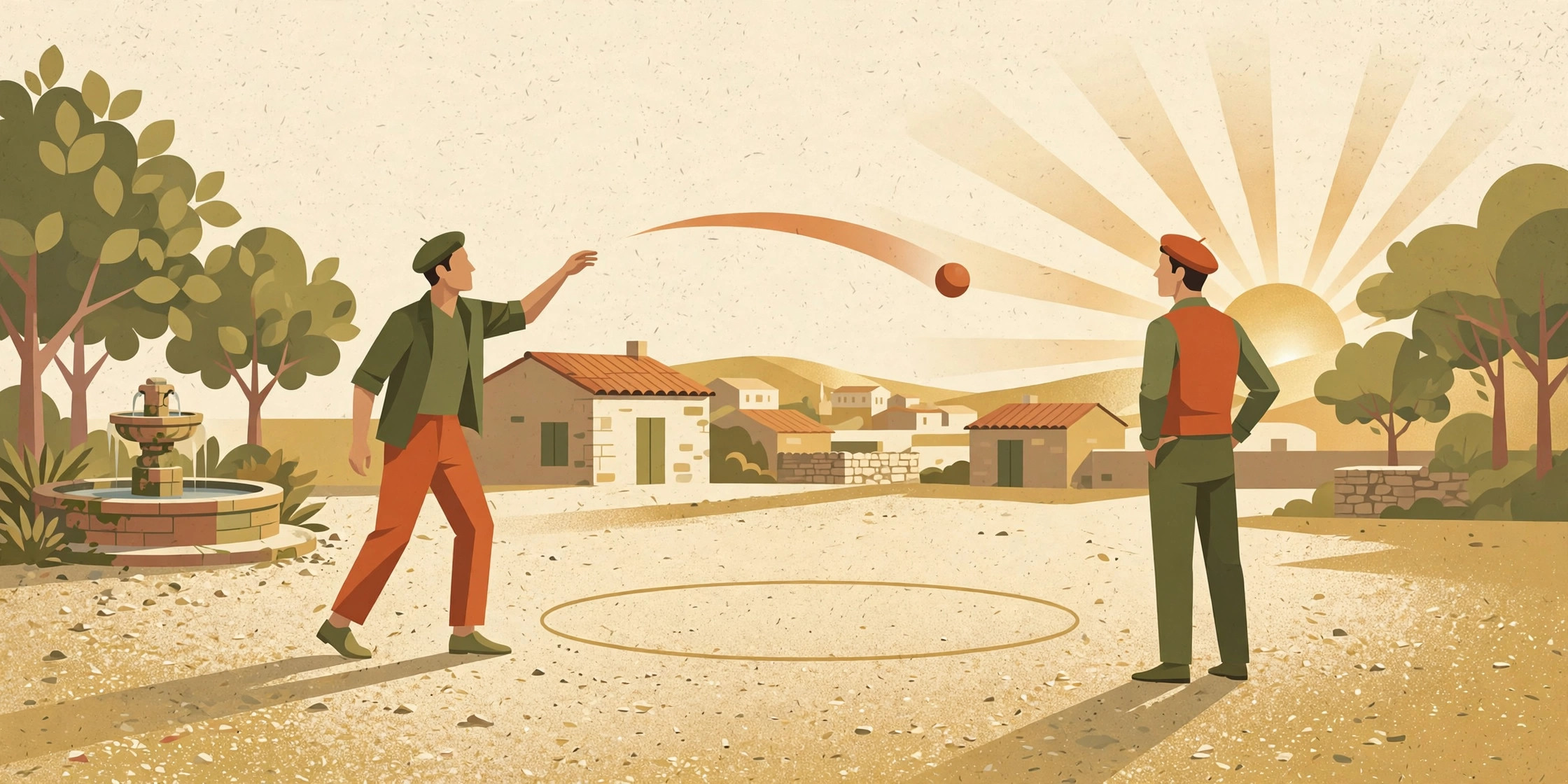
Tête-à-tête (n.m.) — one player against one player, three boules each, no partner, no alibi, no one to forgive and no one to forgive you. The duel format of pétanque, the monastic cell of the game, and the purest mirror the sport holds up to its players.
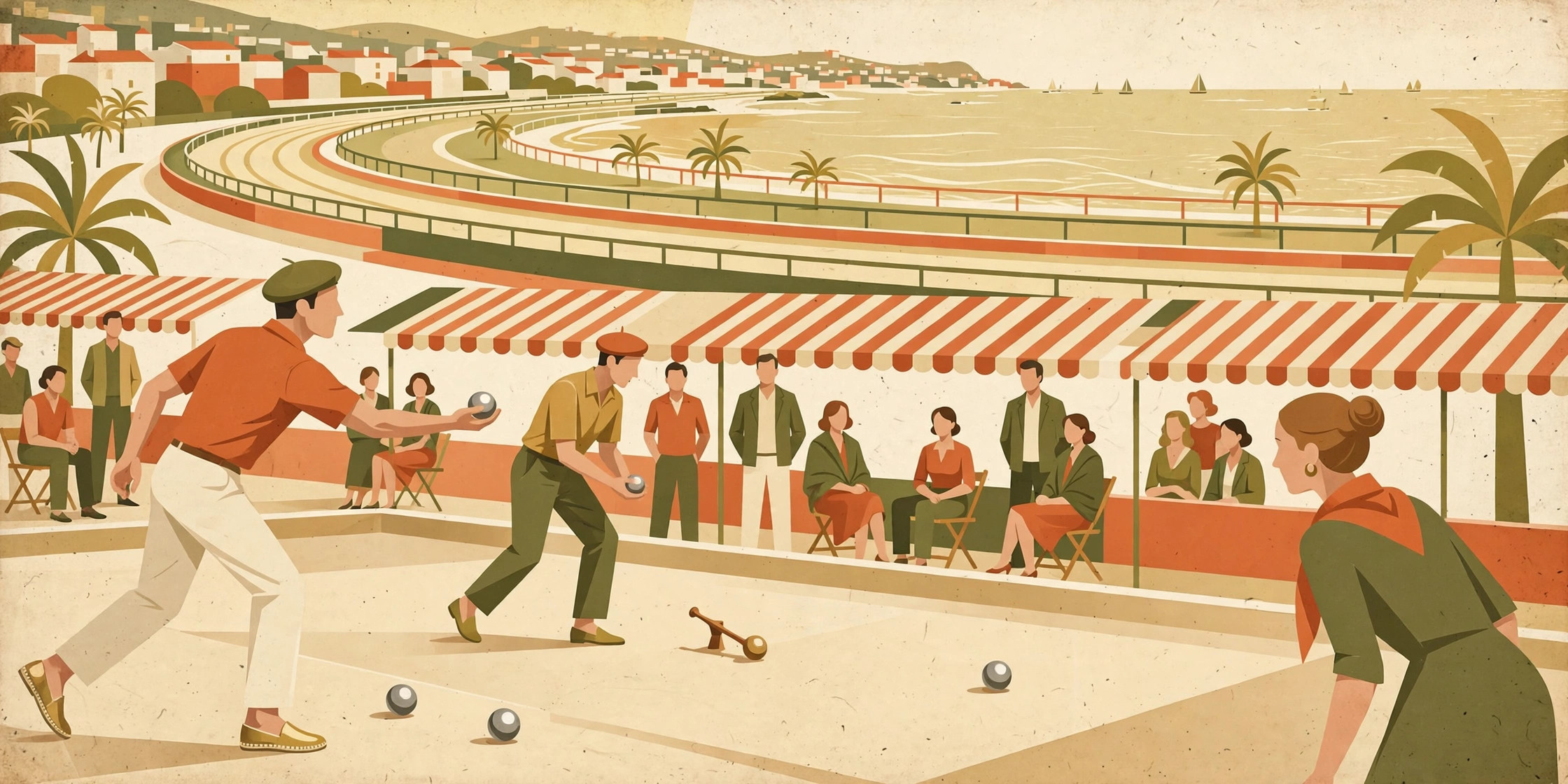
Pétanque comes in three official formats, and choosing one is choosing a way of being. The triplette — three against three, two boules each — is the noisy championship format, a small parliament that throws steel. The doublette — two against two, three boules each — is the village-square default, the game of afternoons and friendships. And the tête-à-tête is the third way: the format of total solitude and total responsibility.
Advertisement
To understand the duel, forget the other two for a moment. There are six boules on the terrain in a tête-à-tête, and you hold three of them. That is the entire arithmetic of the format, and it is devastating: every single throw you make is one-sixth of everything that will happen in the mène, and half of everything your side will ever do. Nothing in pétanque concentrates responsibility like this, because there is no one to concentrate it with.
In a doublette, roles emerge on their own — one player points, the other shoots, and the partnership finds its balance. In a tête-à-tête, you are the pointeur, the milieu, and the tireur all at once, sometimes within the same mène. You place the first boule delicately beside the cochonnet, then step back into the circle and smash your opponent’s boule out of the way, then place the third with hands that have just done violence. The game asks you to be two temperaments — the careful one and the bold one — and to switch between them in the space of a single breath.
The silence
The first thing a newcomer notices in a tête-à-tête is the silence. Six players make a restaurant; four make a conversation; two make something closer to a chapel. The measuring, the walking, the soft knock of steel on steel — and underneath it, nothing. Your opponent says little. You say less.
The doublette entry called the tête-à-tête a monologue, and it is, but it is a monologue performed before a very attentive critic standing six meters away. Every gesture is watched. There is no partner’s chatter to hide behind, no teammate’s shrug to soften a bad throw. The French have a saying for the mercilessness of it, delivered always with a smile: in a tête-à-tête, your weaknesses arrive at the terrain before you do.
The noise in your head
Into that silence rushes the only conversation available: the one inside your own skull. A tête-à-tête is played at two volumes — the hush of the terrain and the uproar of the mind. You coach yourself, contradict yourself, replay the last throw, preview the next one, and conduct an ongoing tribunal on your own judgment. No one in any other format does this much thinking, because no one else is entirely alone with the consequences.
Decision-making in the duel has a particular texture. In a team, strategy is negotiated — a glance, a shrug, a murmured tu tires ou je pointe? — and the negotiation itself spreads the blame. Alone, every decision is a small act of authorship. The line you choose, the risk you decline, the carreau you attempt and miss by a finger’s width: these are yours in a way that nothing in a doublette ever is. Victory has your name on it. So does the rest.
A tête-à-tête is a conversation with yourself that happens to include throwing steel balls — and you will lose the argument at least once per mène.
Losing a tête-à-tête is a private education. There is no partner to absorb half the disappointment, no shared mythology to soften the retelling. You walk off the terrain with the loss the way you walked on: alone, carrying it yourself. The French, who are connoisseurs of defeat in all its forms, treat this as the format’s great virtue. A person who can lose a tête-à-tête gracefully, they say, can lose anything gracefully — and in a life of losses large and small, this is not a useless skill.
Winning, curiously, is quieter than you expect. In a doublette, victory is a duet — the shared glance, the laughter, the immediate rehashing of the decisive mène over the first sip of pastis. Alone, you collect your three boules, shake your opponent’s hand, and feel a satisfaction that has no witness. It is purer, veterans say, and lonelier, and the two adjectives turn out to be the same one.
The etiquette of the challenge
Now the etiquette, because the tête-à-tête has the strictest protocol of the three formats, and newcomers violate it constantly. The rule is simple and absolute: you do not propose a tête-à-tête to a stranger. It is too intimate, too revealing — like suggesting that two people who have just met skip the pleasantries and discuss their childhoods.
Advertisement
A duel must be earned, or at least approached with ceremony. The proper channels are well known: you play a few doublettes together first, you let the idea surface naturally after an apéro, or you let a mutual friend do the suggesting. In the clubs, challenges circulate the way rumors do — quietly, through intermediaries, with everyone pretending they heard it from someone else. To issue a direct, public challenge to a near-stranger is not rude, exactly; it is just understood to be a little brutal, a little American in the worst sense of the word.
Once accepted, the duel runs on formal politeness. You greet each other. You draw the circle. You play. The small courtesies — letting your opponent measure first, complimenting a fine carreau even as it ruins your mène — are not optional extras; they are the entire social contract of the format. Two people, no witnesses, no buffer: the game only works if both players agree, silently, to be sporting about it. Every format has its word for a poor sport, but in a tête-à-tête it is a particular kind of insult, because there is no one else to blame for the atmosphere.
Monks and romantics
Here the two cultures diverge, and the divergence is instructive. Americans discovering pétanque tend to fall for the tête-à-tête first, and it is easy to see why. The United States has a long romance with the solo competitor — the pitcher alone on the mound, the golfer alone with the course, the boxer alone in the ring. The duel looks like the serious format, the pure one, the version of the game where a person finds out what they are made of. Everything else starts to look like its social dilution.
The French see it almost exactly in reverse. The tête-à-tête is respected, certainly — no one sneers at a duelist — but it is regarded as a little ascetic, a little monastic. A player who only plays tête-à-tête is admired the way a hermit is admired: from a respectful distance, with absolutely no desire to join him in the cell. The format carries a faint odor of the cloister — admirable, rigorous, and missing the point, which is the company.
This is not snobbery; it is anthropology. In France, the game is a pretext for the afternoon, and an afternoon spent entirely alone is an afternoon half-wasted, no matter how well you throw. The duel is a test, and tests are for taking occasionally, like exams — nobody proposes to live inside one. The American hears “one against one” and thinks proving ground; the French hear it and think beaucoup de silence, a great deal of silence, and reach for the doublette the way you reach for a second chair.
And yet the French keep the duel alive, and keep it honored, because they understand something the romantics miss: solitude is an ingredient, not a meal. Every serious player has a private history of tête-à-têtes — the ones that taught them to shoot, the ones that taught them to lose, the ones played at dusk against an old master who said nothing and taught everything. The duel is the game’s conscience. It sits in the corner of the sport like a monk at the corner of a feast: mostly silent, occasionally essential, and quietly judging everyone.
The apéro afterward
Whatever the format, pétanque ends the same way: at the table, with glasses. But the apéro after a tête-à-tête has its own particular gravity, because the arithmetic of the game extends to the arithmetic of the drinks. Lose a duel, and honor demands — gently, unmistakably — that you buy the round. One loser, one round, one cleanly settled debt. There is no splitting, no negotiation, no going Dutch.
This is the genius of the custom. The duel’s total responsibility, which felt so heavy on the terrain, dissolves the moment the loser reaches for their wallet. Buying the round is not humiliation; it is the ritual that converts defeat into sociability. The winner accepts the drink, the loser orders it, and within minutes the two of them are rehashing the decisive mène with the generosity of historians. The game ends at thirteen points. The evening, mercifully, has no such limit.
Watch a pair walk to the bar after a tête-à-tête and you will see the format’s real function. On the terrain they were adversaries in the purest sense — no partners, no buffers, no excuses. At the table they are simply two people who have spent an hour paying complete attention to each other, which is rarer and more intimate than it sounds. The duel was the excuse; the apéro was the point. It was always the point.
A small theory of solitude
So what is the tête-à-tête, finally? It is the smallest possible unit of the game — two players, six boules, one circle drawn in the gravel — and the largest possible unit of self-knowledge. Every other format lets you distribute the experience: the doubt, the credit, the blame, the laughter. The duel lets you distribute nothing. What you bring to the circle is what plays.
The French keep a tender, slightly teasing phrase for the whole enterprise, and it captures the national attitude perfectly: the tête-à-tête is le format des courageux, the format of the brave — said with admiration, said with a smile, said by people who will, given the choice, play doublette. Bravery is for admiring. Company is for living.
Play one, then. Find someone you respect, issue the challenge through the proper channels, and spend an hour alone with your game and your thoughts. You will discover exactly how good you are, exactly how sporting, and exactly how loud your own mind can get in the silence between throws. Then lose — or win, it hardly matters — and buy the round.
The boules are the same. The cochonnet is the same. Only the number of hands changes — and with it, everything.