News & Politics
Curfews and the Vote
France votes today on the 2027 budget's revenue section while its cities recover from the worst unrest in years — and curfews aimed at minors go into effect for a second night.
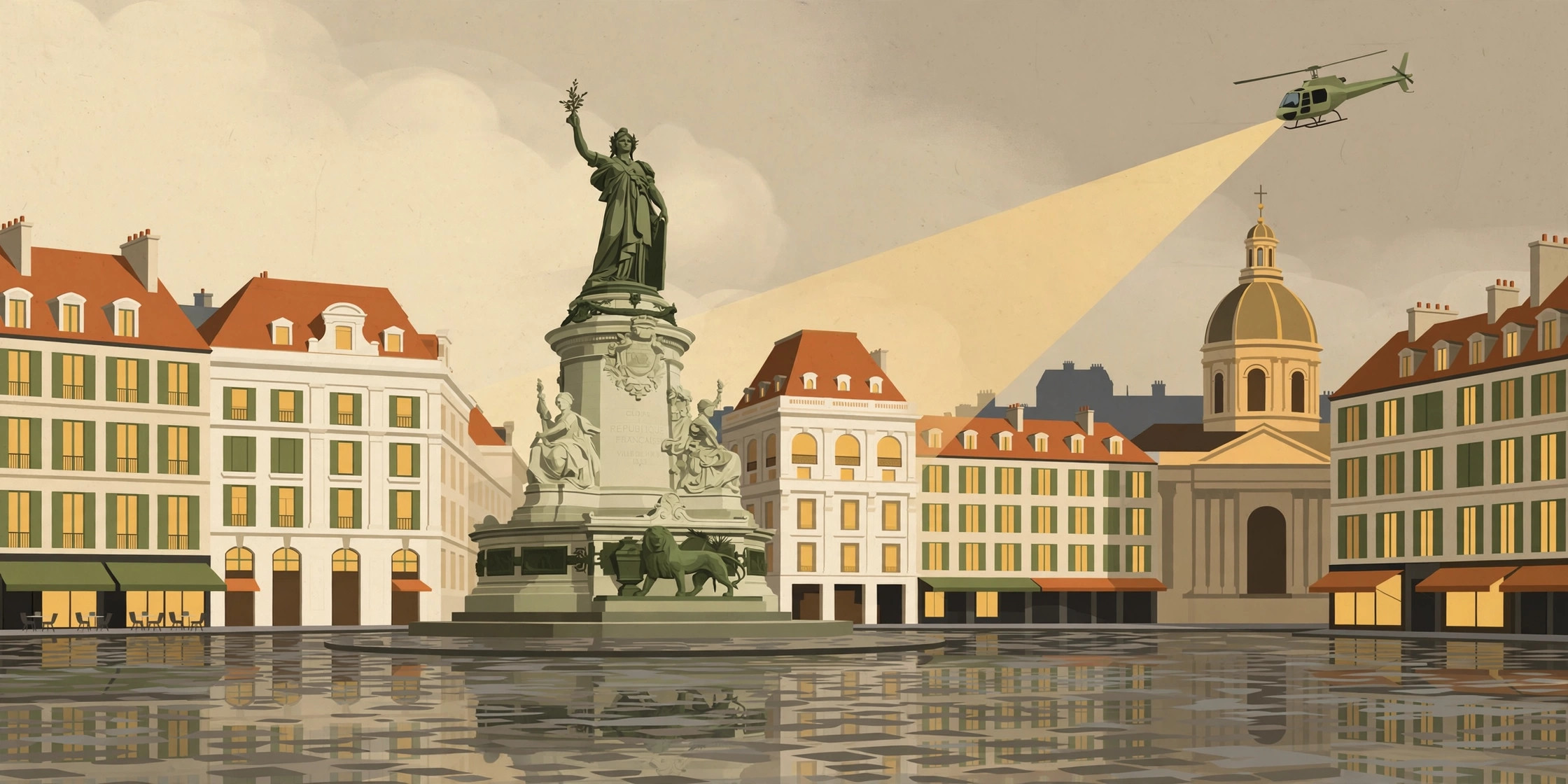
France is doing two things today, and they do not belong together. The National Assembly votes this afternoon on the revenue section of the 2027 budget. And a second night of curfews goes into effect in Paris, Lyon, Lille, Bordeaux, and Nice — curfews for minors, decided city by city, imposed after a weekend when the country saw its worst unrest in years.
The two stories are separate. The question today is whether they stay separate.
Advertisement
The weekend started as protest and ended as wreckage. On Saturday, roughly half a million people marched across France over the cost of living and the state of schools. The roots run deep: since mid-September, schools in the Créteil district outside Paris have been protesting dilapidated buildings and teacher shortages, and the grievance spread nationwide. The marches themselves were, by every account, overwhelmingly peaceful.
Saturday night was not. Rioting and looting broke out across Paris, Marseille, Lyon, and Bordeaux. Roughly 2,400 people were arrested. Nearly 1,000 security personnel were injured. At least two people are dead, and there were serious injuries. Around 3,000 businesses were damaged or looted. In Limoges, the city hall’s roof and clock tower collapsed in a fire. On Place Vendôme, boutiques were attacked. In Marseille, the Olympique de Marseille official store was looted. On Monday, the Louvre was closed after protesters blocked access.
France’s employers’ federation, MEDEF, warned the damage went beyond broken glass: public trust itself was at stake.
The government’s response was fast and two-track. On Monday, Prime Minister Sébastien Lecornu announced “localized” and “partial” curfews, the first night applying in Paris — the Place de la République and Les Halles districts — plus Lyon, Lille, Bordeaux, and Nice. The curfews apply only to minors, decided locally by mayors and prefects, and Lecornu said new curfews would follow on Tuesday where necessary. He did not rule out a state of emergency. People around Emmanuel Macron confirmed it had been “considered, not decided.”
Interior Minister Laurent Nuñez offered his resignation twice over the weekend, admitting failures in planning and intelligence-gathering. Macron refused it — and ordered “full transparency” about what went wrong. Sixty thousand police had been deployed on Saturday. Nuñez admitted it was not enough. On Monday, 200 investigators were assigned to surveillance footage, Marseille banned all gatherings from noon to 8 p.m., and a financial support fund and furlough scheme were announced for ransacked businesses. The PSG–Barcelona Champions League match scheduled for Tuesday night in Paris will go ahead.
Macron addressed the nation on Sunday evening with one reported line that made the front pages: “Those who destroyed must pay.” Then he left the country — a three-day Gulf tour taking in Kuwait, the UAE, Bahrain, and Qatar, officially to secure fuel supplies and bring down pump prices. His critics called it an absence in a crisis.
Today, the Assembly turns to the revenue section of the 2027 budget in what the French call a “vote solennel,” a solemn vote. The social-security budget gets debated October 20 to 26, with its vote October 27. The final full-bill vote comes November 17. The constitutional deadline is December 10. The Assembly stops sitting on February 28, 2027, ahead of a presidential election in April.
The government’s target: bring the deficit from 5.4 percent of GDP down to 5 percent. France’s public debt sits near 119 percent of GDP. And the markets are watching the streets. On Monday, French ten-year yields jumped 13 basis points to 4.9 percent — the largest one-day rise since late September, the first time near those levels since 2002. The spread over German Bunds widened to 146 basis points. The European Central Bank meets October 29. The United States, China, and Germany have all issued travel advisories for France.
The arithmetic in the chamber is delicate. The Rassemblement National’s 122 deputies are the kingmakers: they sank the budget’s rejection motion 236 to 149, and the €30.9 billion EU contribution line passed 111 to 93 with both the RN and La France Insoumise opposed. La France Insoumise is threatening a censure motion if the government reaches for article 49.3 to force the budget through. The unions have called a general mobilization for November 5, and truckers are threatening a blockade of Paris on October 21 over fuel costs.
Advertisement
Read the two French camps, and they are telling different stories about the same weekend.
The government’s version goes like this. The violence was the work of looters and “ultra-left” agitators who attached themselves to a lawful protest and hijacked it. The vast majority marched peacefully — the authorities stress this — and the criminals are a separate matter from the marchers. Order has to come first: hence the curfews, hence Macron’s “those who destroyed must pay,” hence the refusal to apologize for 60,000 police. On the budget, the line is necessity. The deficit must come down. Fiscal discipline is not optional when bond markets are pricing your debt near levels last seen in 2002 and the EU is watching your arithmetic.
The opposition’s version goes like this. The violence did not come from nowhere — it came from a cost-of-living crisis and from schools that have been visibly falling apart for weeks. Marine Le Pen’s camp pairs its law-and-order credentials with a purchasing-power pitch: protect the French, lower the bills, and let the police do their job without excuses. The left, meanwhile, is making the fiscal-justice case: the deficit is real, but the answer is fairer taxation, not more burden on the people who marched on Saturday. Jean-Luc Mélenchon’s circle goes further, with its central-bank-debt platform arguing that France’s debt could be carried differently — financed at the source rather than squeezed out of households.
Both framings have their convenient silences. The government’s order-first posture says little about why half a million people were marching in the first place. The left’s fiscal-justice case says little about what to do with a 5.4 percent deficit when the markets are already restless. The RN’s pitch says little about the arithmetic of its own promises.
The economic fallout is already measurable, and it is the kind that outlasts a news cycle. The government announced a financial support fund and a furlough scheme for ransacked businesses — the state stepping in to cover wages where looting emptied the till. That is standard in France after unrest, and it is also a signal of how seriously the government takes the commercial damage. MEDEF’s warning about public trust is not about this week’s headlines; it is about the investor who reads Monday’s yield numbers and wonders whether French streets are becoming a recurring line item.
Tourism is the softer but very real exposure. The United States, China, and Germany issuing travel advisories in the same week is a combination France rarely sees. Paris in late October is not peak season, but the city runs on year-round visitors, and a closed Louvre on a Monday morning photographs badly. The government’s promise that the PSG–Barcelona match goes ahead on Tuesday night is about more than football: it is a bet that normal life continues, televised to millions, under floodlights, with 60,000 police already proven insufficient on Saturday and the question of whether Tuesday’s deployment can do what Saturday’s could not.
And behind everything sits the calendar. The presidential election is roughly six months away, in April 2027, and the Assembly stops sitting on February 28. Every decision between now and then is made in that shadow. The budget is not just a budget; it is the last full budget of this presidency. The curfews are not just curfews; they are the answer this presidency has for disorder. Macron’s Gulf tour — Kuwait, the UAE, Bahrain, Qatar, fuel supplies, pump prices — was planned as foreign policy. It has become a domestic test: does the president look in control of the price of fuel while his own cities are under curfew?
This is why the opposition’s case keeps landing on the same point. The RN argues that a government unable to keep Place Vendôme intact should not be asking households to accept fiscal discipline. The left argues that you cannot budget your way out of a legitimacy crisis. The government’s answer is that these are separate problems with separate solutions — order in the streets, discipline in the accounts — and that conflating them is exactly what the people who smashed the windows want.
And then there is the curfew itself — perhaps the most contested detail of all. Applying only to minors, decided mayor by mayor, prefect by prefect. The government’s case is that it is targeted and proportionate: a tool aimed at the age group most drawn into the night-time looting, without locking down whole cities. The Greens’ presidential candidate, Marine Tondelier, called it something else: “a curfew cannot be a political response to a social crisis.” Her point, and it is not only hers, is that curfews manage symptoms. They do not fix wages, school buildings, or fuel prices.
That is the tension at the heart of today. A budget vote is a slow, procedural thing — articles, amendments, solemn votes, constitutional deadlines. A curfew is fast and visible. The government is trying to do both at once: restore order in the streets while passing a budget that asks the country for discipline. The risk is that the two collide — that the Assembly’s vote is read through the smoke of the weekend, and the weekend through the lens of the vote.
What to watch: the vote number and the margin. Who voted with the government, and what did it cost them. Whether 49.3 stays in the drawer or comes out. Whether the new curfews hold the second night without fresh damage. Whether the truckers carry out their October 21 blockade threat. And whether the streets and the chamber remain two separate stories — or become one.