News & Politics
The Abyss Is Not for Sale
Washington has ordered a fast track for deep-sea mining in international waters. Paris calls it a violation of international law — and France's ambassador for the oceans has an answer: the abyss is not for sale.
There is a rule in pétanque so basic that nobody bothers to explain it: you throw from inside the circle. You draw your ring in the gravel, plant both feet inside it, and play. Step outside — even a toe over the line — and the throw is dead, a foot fault, as if the boule had never left your hand. The circle is the game’s simplest contract: it tells you where your authority begins, and here, exactly here, is where it ends.
President Donald Trump has just signed an order that steps outside the circle. The directive fast-tracks deep-sea mining in the open ocean beyond American territorial waters — the high seas, where no flag flies, where no nation holds the ring, where the water belongs to everyone and therefore to no one. It is a throw aimed at terrain the United States does not own, at a part of the planet that was never inside anybody’s circle.
Advertisement
France, which takes the rules of the terrain more seriously than almost anyone, called it what it is. Paris accused Washington of violating international law — not bending it, not testing it, violating it — and then sent out its ambassador for the oceans, Olivier Poivre d’Arvor, to say the part that diplomats usually leave unsaid.
“The United States is violating the principle of non-appropriation of the high seas,” Poivre d’Arvor said. “No one can claim the right to destroy the oceans, especially those over which they have no territorial rights.” And then the line that will follow this dispute wherever it goes, the sentence that belongs on a banner: “The abyss is not for sale.”
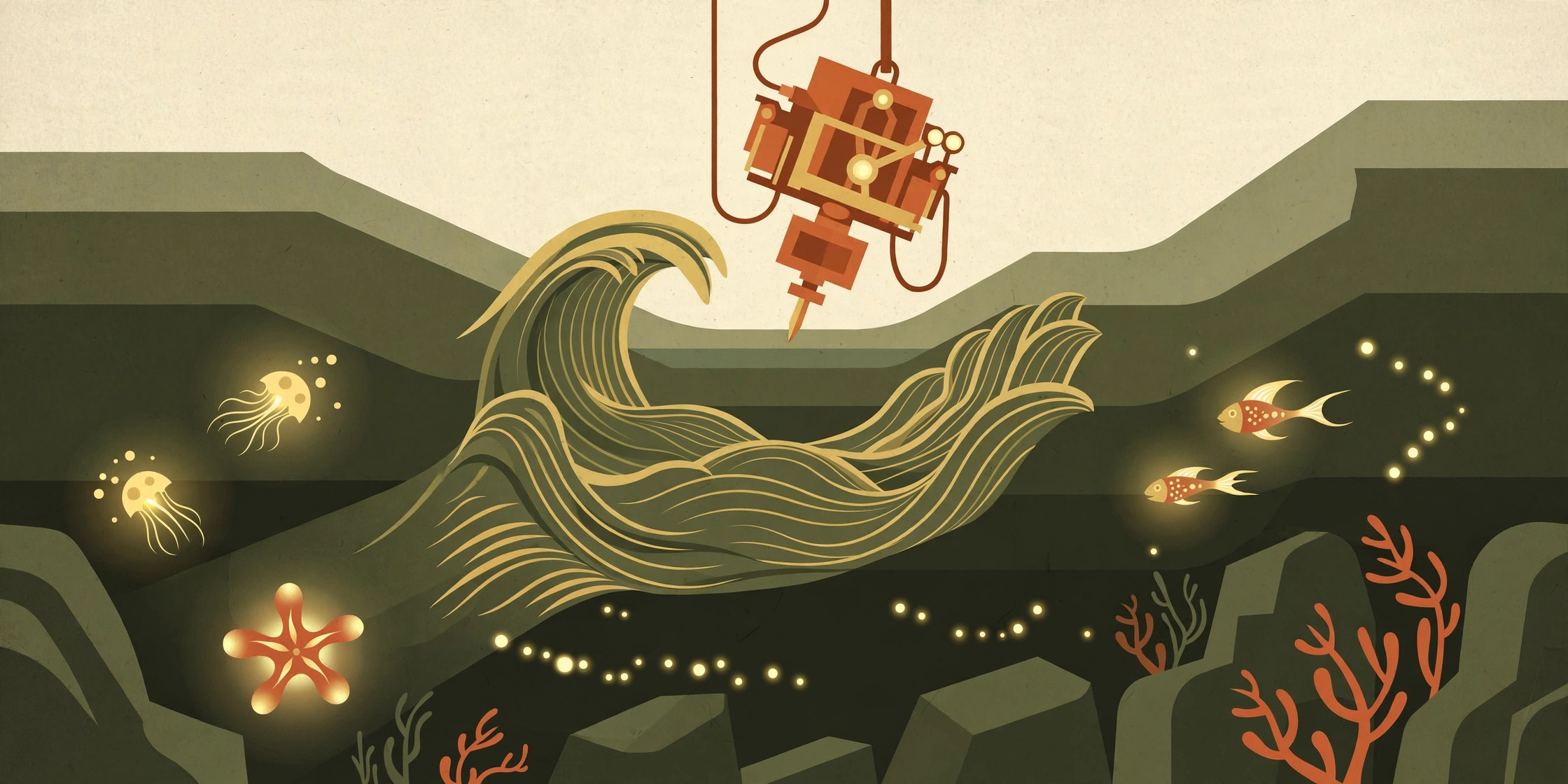
It is worth pausing on that word — abyss. Not the ocean, not the seabed, but the abyss: the part of the map we colored blue and left blank, the last margin of the atlas. Down there, on plains of darkness kilometers below the surface, lie mineral stores essential to modern technology — the metals that go into batteries, electronics, the machinery of the energy transition. The demand for them is real, it is growing, and every capital on Earth knows it. The abyss is not empty. It is a vault.
What nobody knows is what opening the vault will cost. The ecology of the deep ocean is still poorly understood. We have mapped more of the surface of the Moon than of our own ocean floor, and the creatures that live down there, in pressure that would crush a submarine and darkness that has never known a sunrise, have been evolving without us for hundreds of millions of years. To scrape that floor for minerals is to throw your hardest boule into a part of the terrain you have never walked, at a target you cannot see, in the dark.
The referee Washington never hired
Here is the peculiar legal geography of this mène. The high seas are governed — to the extent that anything four kilometers down can be said to be governed — by a body called the International Seabed Authority, a UN-affiliated institution empowered to license and regulate mining on the international seabed. Its founding idea is one of the grandest in international law: that the deep ocean floor is the common heritage of humankind, to be managed for everyone, not seized by whoever gets there first with the biggest dredge.
The United States never ratified the agreements that give the Authority its power, and it is not a member of the body. Washington’s position on the new order is, in effect, that a referee you never hired cannot call your foot fault — that rules written by a club you declined to join do not bind the thrower standing outside it.
Paris sees it exactly the other way around, and the difference is philosophical before it is legal. The principle of non-appropriation — the idea that the high seas belong to no one and therefore cannot be seized by anyone — is, to the French mind, not a membership perk but the ground itself. You do not get to claim the gravel just because you brought the biggest boule. Some rules are not the house rules of a club; they are the condition of there being a game at all.
France has acted on that belief the way France always acts: by pointing. It has led a diplomatic push for a global moratorium on deep-sea mining, and it has built a coalition of thirty-two countries opposed to any extraction until the long-term impacts are properly understood. Thirty-two nations, ranged around a principle like boules around a jack. It is the quintessential French throw — patient, precise, placed rather than hurled — and it is designed to make the other side’s boule look reckless by comparison.
Because that is the thing about France in international affairs: it points. Its instinct, in diplomacy as in everything, is placement. The resolution, the coalition, the carefully drafted moratorium, the communiqué with thirty-two signatures — boules laid one after another around the cochonnet of a shared principle until the position becomes undeniable and the opponent, studying the terrain, quietly runs out of good throws.
Advertisement
America tires. Its instinct is the strike: the executive order, the unilateral move, the throw that clears the whole end before the other team has finished placing. Where Paris spent years assembling thirty-two nations around a principle, Washington spent an afternoon signing a document that renders the principle, from the American point of view, moot. Pointing accumulates; shooting decides. At least, that is the theory of the tir.
The theory has a hole in it, and the hole is the one Poivre d’Arvor named. A tir in pétanque is magnificent, but it is still thrown from inside the circle — that is what makes it legal, what separates the great shooter from the vandal. The American order reaches beyond American waters into a space where the United States has, by the admission of its own legal tradition, no territorial rights. You can be the finest shooter on the terrain and still be called for the foot fault. The circle does not care how far you can throw.
What the darkness is worth
Strip away the law for a moment and the mène looks simpler, almost sympathetic: down there are the minerals, up here is the hunger for them. The green transition runs on metals. Every battery, every wind turbine, every electric motor is a small inventory of the periodic table, and the land-based mines that supply them come with their own ledgers of damage — the deforestation, the poisoned rivers, the labor conditions no one wants to look at too closely. The seabed offers a terrible, seductive arithmetic: what if the cleanest mine is the one nobody can see?
That is the American argument at its most sympathetic, and it deserves to be stated plainly, because it is not nothing. If the minerals are essential to modern technology — and they are — and if the alternative mines scar the visible Earth, and if the international body that would regulate the whole affair is one you never joined, then waiting starts to look like a luxury. And it is a strategic luxury, too: the world’s appetite for these metals is not pausing for anyone’s moratorium. Why ask permission from a circle you never stood in, to harvest a floor no one owns?
Because the circle is the ocean, and the ocean does not negotiate. The deep sea is not an empty warehouse waiting to be inventoried; it is an ecosystem we have barely begun to catalog. Scientists discover new species down there on nearly every expedition — creatures of glass and bioluminescence, whole food webs built on whale falls and chemical vents, living at a pace so slow that a single mining operation could outlast the recovery time of everything it touches. A nodule field that took millions of years to form can be vacuumed up in an afternoon. We are proposing to harvest a place we have not finished exploring, to spend an inheritance we have not finished counting, and to call the proceeds progress.
France’s thirty-two-country coalition is, at bottom, an argument for the pause — for the dink, to borrow the other game in this magazine’s quiver. The moratorium does not say the minerals must never be touched. It says: not until we understand what touching them costs. It is the soft shot played close to the net, the patient placement that keeps the rally alive while the science catches up. In a mène full of flying iron, the dink is the bravest shot of all, because it is the only one that admits what it does not know.
The pointer places. The shooter strikes. The abyss — the abyss is not for sale.
Notice who is playing for which team, because the formations are revealing. France is not throwing singles here; it is once again the designated pointer for a squad — thirty-two nations this time, ranged around a principle. It is the same role Paris plays in the trade disputes, the same instinct: assemble the team, place the boules, let the position speak. And the United States, for its part, has taken the loneliest position in the game — the shooter who has decided that the circle is wherever he happens to be standing, and that the terrain beyond his feet is his to play.
There is a French verb for what happens next, and it is attendre — which means to wait, but also to expect, and also, in its older sense, to lie in wait. The order is signed; the fast track is open; American companies can now seek to mine the international seabed under American permits, beyond the reach of the Authority that Paris defends. The coalition will keep pointing — more signatories, more resolutions, more of the slow diplomatic placement at which France excels. The question hanging over the terrain is whether any of it can move a boule that has already been thrown, or whether the game has simply moved to a bigger, darker, less governable ground.
History suggests the mène is longer than it looks. International law is a slow pointer; it rarely stops the first throw. The foot fault gets called, the shooter shrugs, the game goes on. But the law has a way of making the second throw harder and the third harder still — of narrowing the terrain, raising the cost, turning today’s unilateral fait accompli into tomorrow’s diplomatic liability, until the shooter finds his circle shrinking around him. The principle of non-appropriation survived the age of empires, when the great powers claimed whole oceans by decree. It may yet survive the age of the executive order.
And then there is the cochonnet itself — small, gleaming, absurdly modest for all the iron being thrown around it. “The abyss is not for sale.” A handful of words that say what the entire dispute is actually about: whether the last unclaimed places on Earth are a commons to be protected or a warehouse to be opened, whether everyone’s means no one’s to take. Every future argument about the deep sea will be measured against that little jack. It is the one boule in this mène that cannot be shot away, because it is not a position on the terrain. It is the terrain.
So the circle is drawn, the feet are planted, and the throw is already in the air. Washington has aimed beyond its waters, down into the darkness beneath them. Paris has called the foot fault, and thirty-two nations are standing behind the call, pointing patiently at the principle. The abyss waits below — patient, unlit, unimpressed by the commotion on the surface — for the players to remember the first rule of the game. You throw from inside the circle. Or you do not throw at all.