News & Politics
The €30.9 Billion Vote Nobody in Brussels Wants to Discuss
France's parliament approved its EU budget contribution for 2027, but the vote exposed how fragile the consensus behind Europe's next seven-year budget really is.
On Wednesday, the French parliament did something it almost never does: it approved a large check written to Brussels.
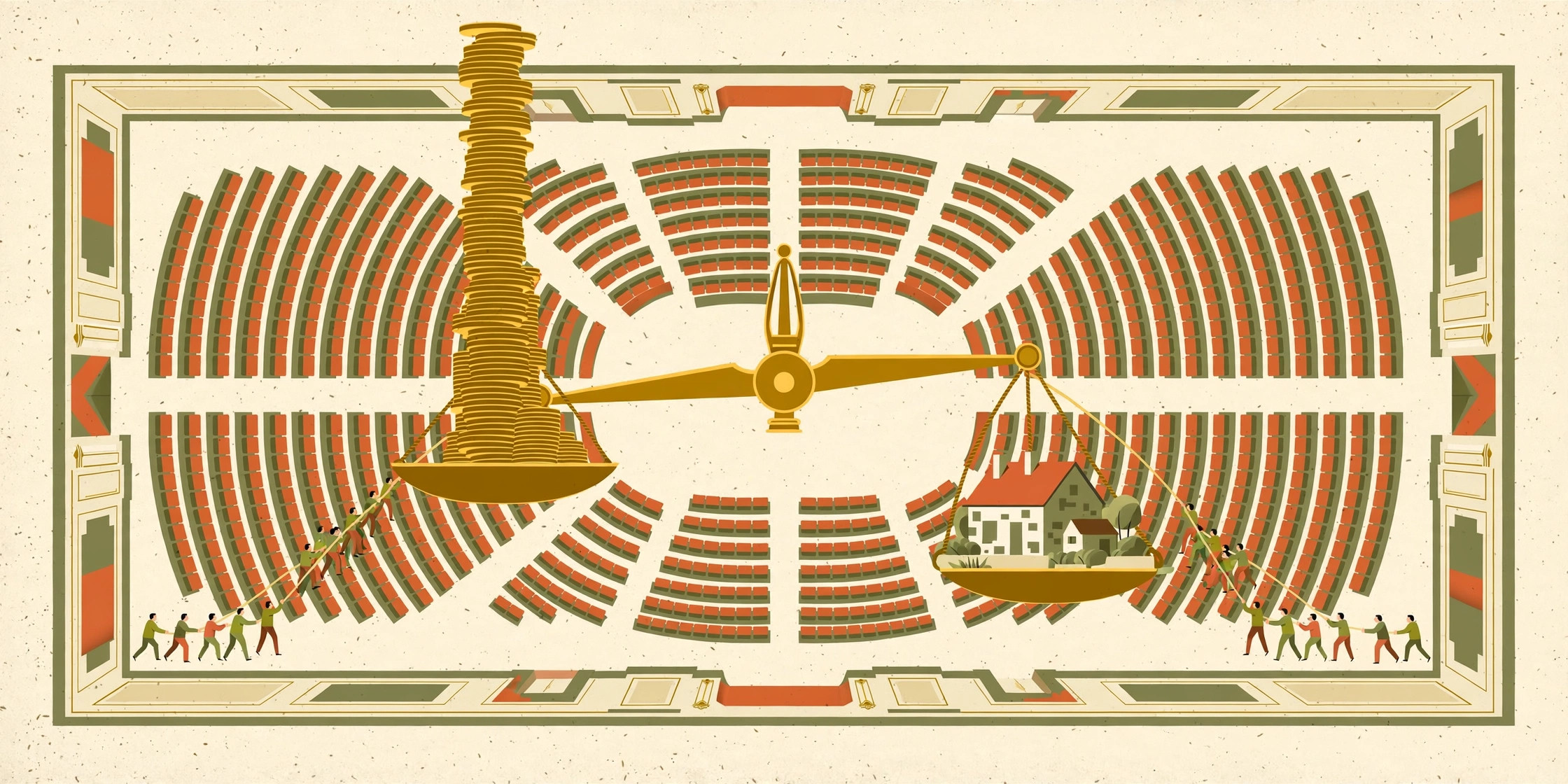
The Assemblée Nationale voted 111–93 to approve Article 55 of the draft budget bill. That article fixes France’s contribution to the European Union budget for 2027 at €30.9 billion. It is an increase of roughly €2.1 billion from 2026, when France paid €28.8 billion. In 2025 the figure was €23 billion; in 2024 it was €22.3 billion.
Advertisement
Read the sequence again. €22.3 billion, €23 billion, €28.8 billion, €30.9 billion. The number keeps climbing, and every year the climb gets harder to explain.
The vote was close because the consensus is thin. On the far right, Marine Le Pen’s Rassemblement National voted against. On the far left, Jean-Luc Mélenchon’s La France Insoumise voted against. The government held its majority together. That is all it held.
What the government says
The government’s argument is arithmetic, not romance. France pays into the EU budget, but France also receives from it — and in absolute terms it is the largest recipient of EU funds in Europe, getting back around €16.5 billion a year through the common agricultural policy, research programs, and regional cohesion funds. That is the figure cited by the Ministry for Europe.
The parliamentary rapporteur on the budget, Philippe Juvin, added a legal point with political edges: striking the contribution from the bill would not actually exempt France from paying it. The payments are governed by EU law and existing commitments. A parliamentary refusal to budget for them would create a legal gap, not a saving.
Benjamin Haddad, the Minister for Europe, made the same case in plainer language. France’s farmers, its regions, and its businesses are major beneficiaries of EU spending, he said. The contribution is the price of being inside the room where those decisions are made.
The underlying message: these are commitments already signed. Europe is not a subscription you cancel when the bill rises.
What the opposition says
Le Pen’s answer is that the commitments themselves are the problem. She has proposed cutting France’s contribution by €11 billion and imposing a strict €5 billion ceiling on the net contribution — the difference between what France pays in and what it gets back. That would mean treating the EU budget the way a household treats a rising utility bill: not as fate, but as negotiable.
She went further this week. She travelled to Brussels to urge European leaders to postpone the decision on the EU’s 2028–2034 multiannual financial framework until after France’s 2027 presidential election. A pre-election agreement on the seven-year budget, she said, would be “a democratic scandal.”
This is not a technical objection. It is a claim about legitimacy. The next EU budget will lock in spending priorities for seven years. If it is agreed before the French presidential election, the next president — possibly her — will inherit obligations set by a government and a parliament that no longer exist. Whether you call that prudent planning or democratic theft depends on where you sit.
The other opposition
Mélenchon’s La France Insoumise also voted no, but for a different reason. LFI’s fight is not with Brussels; it is with the budget as a whole. On the same day as the EU vote, LFI published a counter-budget forecasting roughly €106 billion in extra revenue, about €82 billion in new spending, and roughly €25 billion in debt reduction. Economists who reviewed it called the figures under-specified and overly optimistic.
That matters because it shows how the budget fight is really structured. The government says the accounts must add up and the commitments must be honored. The right says the commitments are too big and should be renegotiated. The left says the money exists — tax it, spend it, cut the debt — and the government’s numbers are the problem. Three diagnoses, three incompatible medicines.
The markets are watching
Outside parliament, the audience that frightens ministers most is not the opposition. It is the bond market.
The International Monetary Fund has urged France to show urgent fiscal discipline. The European Central Bank has said France needs to reassure investors, as yields on the 10-year government bond climb. France’s public debt stands at roughly 119% of GDP.
Advertisement
This is the context the €30.9 billion sits inside. A country with debt at 119% of GDP does not have an easy time explaining a rising EU contribution — not to its parliament, and not to the investors who will buy its bonds. The government’s counter is that refusing to pay would frighten markets far more than paying does. Both arguments are plausible. That is why the vote was 111–93.
And there is public opinion. A recent poll shows broad support among French voters for negotiating a lower national contribution. Voters, like parliaments, can count. The figure rises every year, and the explanation for the rise — new EU programs, new priorities, new commitments — has not caught up with the number.
Brussels, Thursday
The timing is awkward. On Thursday, the day after the French vote, EU leaders met in Brussels to discuss the 2028–2034 budget — the very framework Le Pen wants postponed. The meeting ended without resolution. The divisions are familiar: the European Commission has proposed a plan of roughly €2 trillion over seven years, and Ireland, which currently holds the EU presidency, has proposed cutting roughly €140 billion from it.
The so-called frugal states — Germany, Sweden, the Netherlands — are pushing for deeper cuts. They want a smaller budget. The Commission wants a bigger one. France, the second-largest net contributor, sits in the middle with a parliament that barely approved the current contribution.
This is the Brussels reality the French debate ignores at its peril. Every country arrives at the table with a parliament behind it. France’s contribution is not set in Paris; it is the product of a negotiation where everyone is under the same domestic pressure. When Germany wants cuts and France wants its farmers funded, the result is always a compromise that pleases nobody.
The American parallel
Americans watching this may recognize the pattern. Every few years, the United States Congress debates how much the country should pay into institutions it does not fully control — the United Nations, NATO, the World Bank. The arguments are identical: the money comes back in influence and contracts; the money could be spent at home; the commitments were made by someone else.
France has the European version of the same argument. The government speaks the language of commitments and returns. The opposition speaks the language of the taxpayer. The difference is that in France, the debate is not about whether to participate in Europe. Nobody serious proposes leaving the EU. The debate is about price — and about who gets to set it, and when.
What Le Pen actually wants
The Le Pen interview that landed this week deserves a careful read. Speaking to the Financial Times on Oct 14, she described France as being in “an extremely dangerous situation today.” The fiscal picture is one part of that. Another part is Ukraine.
She said that if elected, she would halt France’s bilateral financial aid to Ukraine within six months — though training and operational support might continue. She also opposed additional EU support measures that would increase France’s burden.
Consider what that means for the budget vote. Le Pen’s position is not only that France pays too much to Brussels. It is that France should not be paying what it pays, to whom it pays it, at all. The €5 billion net-contribution cap, the Ukraine aid cut, the postponement of the seven-year budget: this is a coherent program for shrinking France’s European and international commitments. Supporters call it sovereignty. Critics call it retreat. The FT interview was Le Pen presenting the program to the market before the election, the way the IMF presents its warnings before the crisis.
The France–USA mirror
There is a transatlantic echo here worth noticing. In the United States, the argument over international spending — foreign aid, NATO contributions, Ukraine funding — runs along the same lines: one side sees commitments as the price of leadership, the other sees them as money better spent at home. France’s debate over its EU contribution is the same argument in a different institutional shape.
The difference is scale and structure. American international spending is discretionary in a way the EU budget is not. France’s contribution is a legal obligation under treaties; refusing to pay is a legal act with legal consequences, not a budget line item. That is Juvin’s point, and it is why the government’s position, however unpopular, has the force of law behind it.
But legality is not legitimacy, and Le Pen’s challenge is precisely that distinction. If voters elect a president who campaigned on renegotiating the contribution, the legal obligation becomes a political question. That is what makes her call to delay the seven-year budget decision genuinely significant. It is not about €30.9 billion. It is about who writes the next €2 trillion.
What happens next
The budget bill continues its parliamentary course. The EU contribution for 2027 is now budgeted; the legal obligation exists. But the margin — 111 to 93 — is a signal, not a settlement.
The real fight is the one scheduled for after the 2027 presidential election: the 2028–2034 multiannual financial framework. If Le Pen’s call for postponement succeeds, the current government negotiates a holding position and the next president sets France’s terms. If it fails, the framework is agreed before the election, and the next president inherits it.
Either way, the number keeps climbing. €22.3 billion, €23 billion, €28.8 billion, €30.9 billion. Sooner or later someone has to explain the trajectory — to parliament, to voters, and to the bond market. Wednesday’s vote was the closest anyone has come to refusing to explain it. It will not be the last.