News & Politics
A Boycott in Orbit
Four American space companies pulled out of Emmanuel Macron's Paris space summit under pressure from Washington — and France answered by drawing its own circle in the sky.

In pétanque, the circle is drawn with the toe of your shoe. You crouch inside it, both feet planted, and you do not leave it until your boule has landed. It is a small chalky ritual of sovereignty: this ground, for this throw, is mine. Early in September, Emmanuel Macron convened a space summit in Paris — and when the time came to gather, four American companies refused to enter his circle.
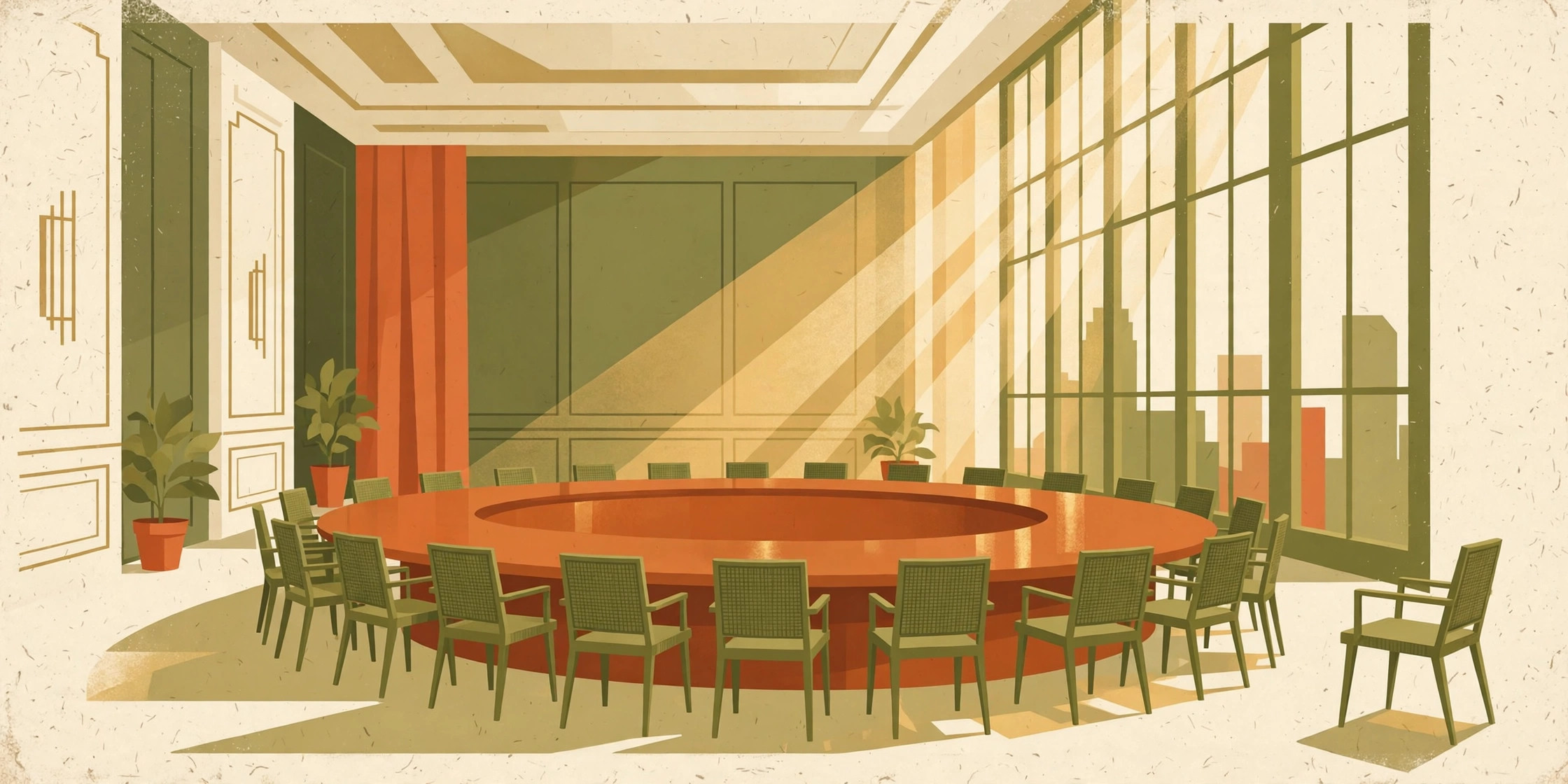
The four were SpaceX, Blue Origin, Stoke Space, and Starcloud. They withdrew from the summit after coming under pressure from the Trump administration, according to reports in early September. Four chairs, left empty around a Parisian conference table. The snub was the message. A boycott does not argue; it demonstrates. Nothing says “we do not recognize your circle” quite like staying out of it.
Advertisement
The gesture has a long transatlantic pedigree. America does not do the quiet démarche. When Washington is displeased, it performs its displeasure — the walkout, the empty chair, the press statement with the volume turned up. This is the tir instinct at its purest: the big iron throw, aimed not at a specific boule but at the whole arrangement, the scatter, the spectacle. Nobody has to be told what happened. The whole terrain sees the chairs standing empty.
It was also, in fairness, a perfectly legible move. A space company that depends on government contracts and launch licenses does not defy a White House that has told it to stay home. Sovereignty cuts both ways: the companies answer to the circle drawn in Washington, not the one drawn in Paris. The Trump administration reportedly made its preference clear, and the companies complied. In the hierarchy of circles, theirs is the bigger one.
The empty chairs
But here is the thing about an empty chair: it is still a chair. It holds its place at the table, and everyone else sits around it and carries on the meeting. A boycott is only as powerful as the event it empties, and the event, by all accounts, went ahead. The summit convened. The speeches were given. The photographs were taken, with four conspicuous absences — which is to say, with four conspicuous presences. An empty chair in a summit photograph is louder than any seated guest.
The French instinct, confronted with a boycott, is not to chase the absentees. It is to point. France does not throw iron at empty chairs; it places its boules closer to the cochonnet. And that is precisely what happened. In the wake of the pullout, Macron announced an additional $4.88 billion in military space spending between 2026 and 2030, bringing France’s total military space spending to $11.85 billion. The message was legible too: if you will not sit at our table, we will build our own table — and our own rockets, and our own sky above it.
This is autonomie stratégique in its purest form, and it is a deeply French move. The American instinct is the dramatic withdrawal — the slammed door, the grand gesture, the room noticing you are gone. The French instinct is placement: sovereignty built one boule at a time, the patient accumulation of capabilities until the position is undeniable. America shoots; France points. One clears the terrain. The other conquers it.
The four absentees
SpaceX, Blue Origin, Stoke Space, Starcloud — the four names read like a starting lineup, and each absence said something slightly different. SpaceX is the shooter nobody argues with: the heaviest iron on the terrain, the company whose rockets have redefined the modern game. Blue Origin is the patient pointer with the deepest pockets, playing the long game by temperament as well as by necessity. Stoke Space and Starcloud are the newcomers — young boules, freshly polished, for whom an invitation to a presidential summit was a coming-out and a snub all at once.
For the two smaller companies, the withdrawal must have stung in a particular way. A startup does not get many chances to sit at a head of state’s table. Being told to stay home by the White House is a reminder of the pecking order: your circle is drawn inside ours. You play where we say. The big players absorb the slight; the small ones feel it. In pétanque terms, they were asked to sit out a mène they desperately wanted to play.
And yet even their absence advertises them. A boycott photographs the empty chairs, but it also photographs the name cards left on the table — four American logos, facing nobody. Paris kept the cards. The cards are still there, waiting.
Drawing the circle in the sky
It is worth pausing on what strategic autonomy actually means in space, because the allegory is almost too perfect. In pétanque, you draw a circle and you stand in it. In orbit, there is no circle — there is only the question of whose launchers carry whose satellites, whose ground stations talk to whose constellations, whose industrial base can replace a lost capability. Dependence on another country’s rockets is the orbital equivalent of borrowing someone else’s boules. It works fine until the afternoon it does not.
Advertisement
Europe has been living this dependence for years, and it has learned the lesson the hard way. When a continent cannot reliably put its own payloads into orbit, its summit invitations carry a certain pathos: please come and admire the sky with us, from our chairs, which we built ourselves, but via launchers we rent from you. The boycott simply made the pathos visible. France’s answer — nearly five billion more for military space, a sovereign sky funded through the end of the decade — is the pointer’s answer: not a scream, but a placement. One boule, then another, then another, until the position around the cochonnet is French.
There is a delicious irony in the fact that the boycott may do more for French strategic autonomy than any French speech ever could. Nothing sells a sovereignty program like a demonstration of dependence. The empty chairs are, in this sense, a gift: four American companies, by declining to attend, made the most eloquent possible case for the very thing Paris has been preaching for years. Macron could not have scripted it better if he had paid them to stay home.
The shooter aims at the arrangement. The pointer aims at the future — and the future is the only target that cannot be dodged.
The two capitals, once again, are playing different games on the same terrain. Washington’s move is the tir: the pressure campaign, the withdrawal, the theatrical absence. It clears the end. It gets headlines. It reminds everyone who has the biggest rockets — which is to say, who has the most iron to throw. But iron throws are expensive, and they are, by nature, subtractive. A boycott removes. It does not build.
Paris’s move is the point: the budget line, the multi-year program, the unglamorous accumulation of launcher capacity and sovereign constellations. It does not make headlines the way a boycott does, but it does something a boycott cannot: it changes the facts on the ground — or rather, the facts in orbit. Seven billion dollars of military space spending does not shout. It accumulates. And accumulation, in the long run, is how you win the mène.
Pointing vs. shooting
Notice the asymmetry in what each side risks. The American companies risked a presidential frown. That is a real risk — nobody wants to be the boule the shooter is aiming at — but it is a risk within a game they already play every day. The withdrawal cost them nothing but a trip to Paris. France, by contrast, is betting billions of euros on the proposition that sovereignty is worth the price of duplication. Two industrial bases where one would suffice. Two sets of launchers. Two circles, drawn separately, in the same sky.
This is the eternal transatlantic argument, restaged at altitude. America believes in the economies of the single circle: one hegemon, one set of rules, everyone welcome inside as long as they play by the house règlement. France believes the single circle is a trap, and that true sovereignty means being able to throw even when the hegemon takes his boules and goes home. It is the same argument France has been making about everything from cinema quotas to cloud computing, now extended thirty-six thousand kilometers up.
The pickleball half of the allegory deserves its moment too, because a boycott is, in its way, a dink — or rather, the refusal to dink. The dink is the soft shot, the rally-keeper, the patient exchange at the net that says we are still in this together. Diplomacy runs on dinks: the working groups, the technical exchanges, the low-stakes meetings where cooperation survives political storms. By staying home, the four companies refused the dink. And France, in response, did not smash; it placed. It kept rallying, quietly, with its own budget lines.
What happens next is the interesting part. A boycott is a wasting asset, like every tir. The shock of the empty chairs fades; the photographs yellow. But the budget line remains. If Europe actually builds the launchers, fields the constellations, and develops the sovereign military space capability that $11.85 billion buys, then the next summit will not need the absentees — and the absentees will know it. That is the nightmare of every shooter: that the terrain, cleared of his iron, turns out to be perfectly playable without him.
There is also, let us be honest, a domestic audience for all of this. Macron’s announcement is aimed partly at Washington — we noticed, and we are not begging — but mostly at Paris, and Brussels, and the European defense ministries being asked to foot the bill. The empty chairs are useful at home too: nothing unites a room like an outside snub. The boycott gives France’s strategic-autonomy lobby exactly the story it has always wanted to tell, gift-wrapped, with four corporate logos on the box.
For now, the circle is drawn and the chairs are empty. The cochonnet — a genuinely autonomous European space capability, a summit that convenes on its own terms — sits gleaming in the middle of the terrain, absurdly small next to the billions being thrown at everything around it. The American players have walked away from the table. The French player has crouched lower, studied the sky, and placed another boule. The long game, as always, belongs to the pointer. The sky is patient. It can wait for the circle to be drawn beneath it.