Pétanque
The Triplette
Three players, two boules each, one job apiece — except the middle guy, who gets two. Ray Delgado on the triplette, pétanque's hardest formation to get right.
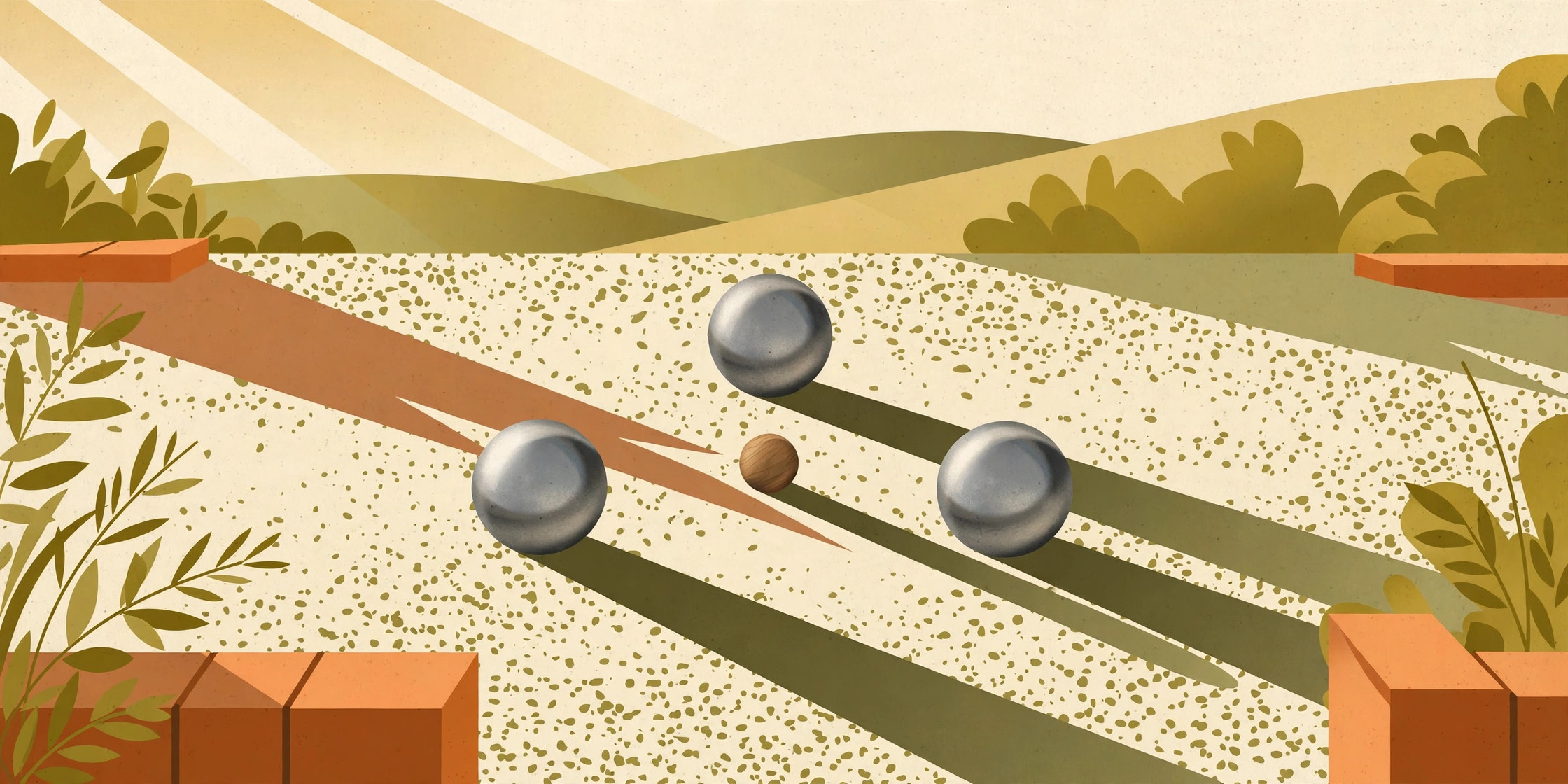
Pétanque has three formations. Tête-à-tête is one player, three boules, all on you. Doublette is two players, three boules each, a partnership. Triplette is three players, two boules each — and it is the one that breaks teams.
Here’s why. In a doublette, you each have three boules. You can afford a mistake. In a triplette, you have two. Every throw matters twice as much, and you can’t fix your own mess — your partner has to do it, or your other partner, and now everybody’s thinking about everybody else’s throw instead of their own.
The triplette has three jobs, and they’re not equal.
The pointeur goes first. His job is to put a boule close to the cochonnet and give the team something to defend. A good pointeur is calm the way a good plumber is calm. Nothing surprises him. He has seen this exact situation four hundred times.
The tireur is the shooter. He comes in when the other team has the point, and his job is to remove it. Tireurs are a different species. They want the big throw. They live for the carreau. A tireur who is “feeling it” can win you a game in ten minutes. A tireur who isn’t will lose it in five.
And then there’s the milieu. The middle player. He points when the team needs a point and shoots when the team needs a shot. He plays after the pointeur and before the tireur, which means he inherits every problem and hands off every solution. Ask any coach: the milieu is the hardest position in the game. You don’t put your best pointer or your best shooter there. You put your smartest player there — the one who reads the terrain, counts the boules, and knows which problem is actually the problem.
The great triplette teams talk constantly. Not strategy-talk, just information: where the cochonnet sits, which boule is whose, what the ground does on the left side. The bad ones go quiet, and then you can watch the game fall apart one silent mène at a time.
Americans coming from team sports expect a captain, a playbook, a huddle. Pétanque gives you three people, six boules, and a circle drawn in the dirt. That’s the whole organization chart. It works because everybody knows the jobs. Point. Shoot. Think.
If you’re starting a team, here’s the rule: pick your milieu first. The pointer and the shooter will find each other. The thinker is the one you can’t replace.
Advertisement