Pétanque
The US Open of Pétanque
In Manhattan's parks, La Boule New Yorkaise has turned a French village pastime into a New York institution — and with the US Open of Pétanque coming to town on October 10–11, the season is heading for its loudest weekend yet.
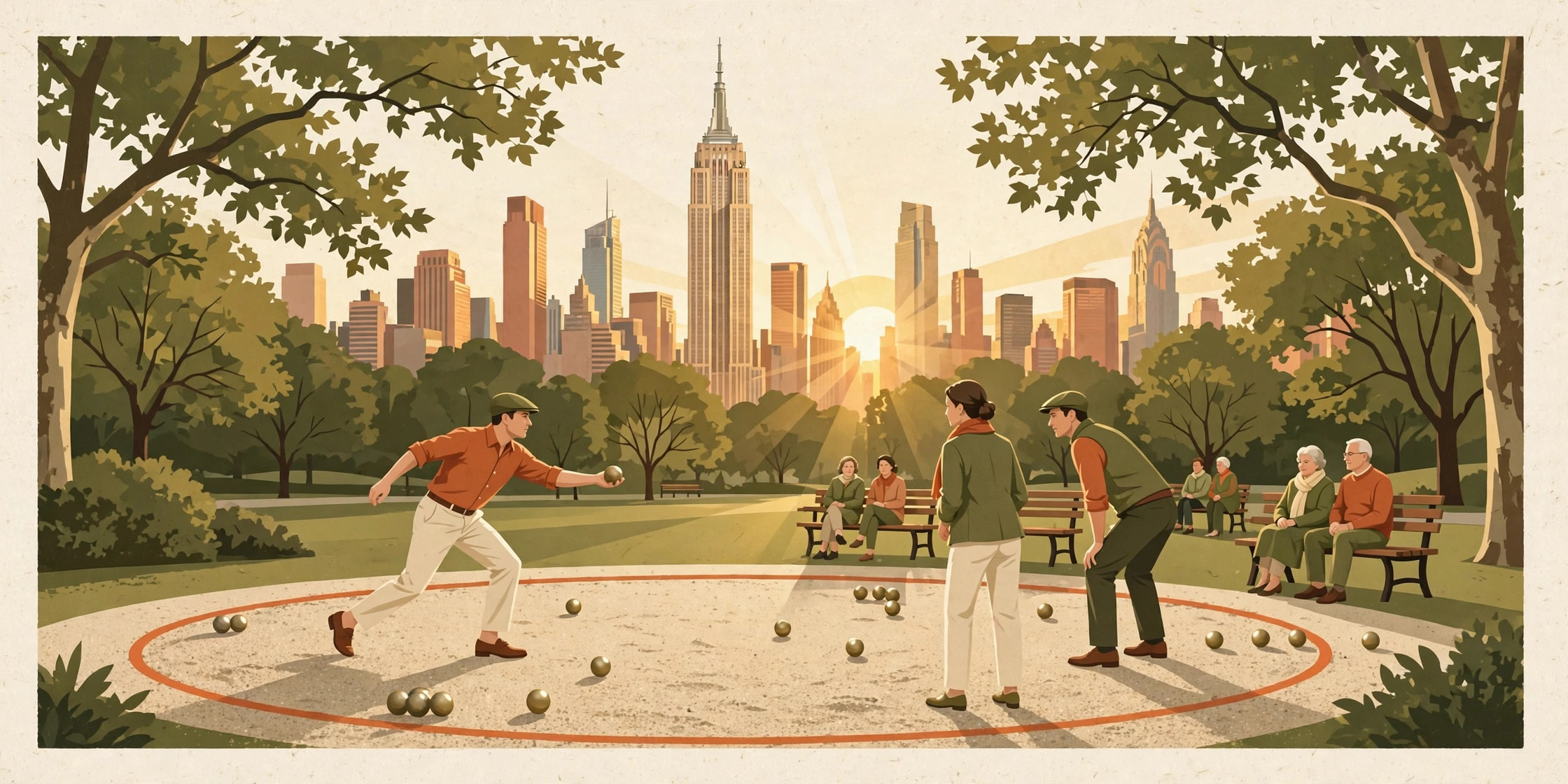
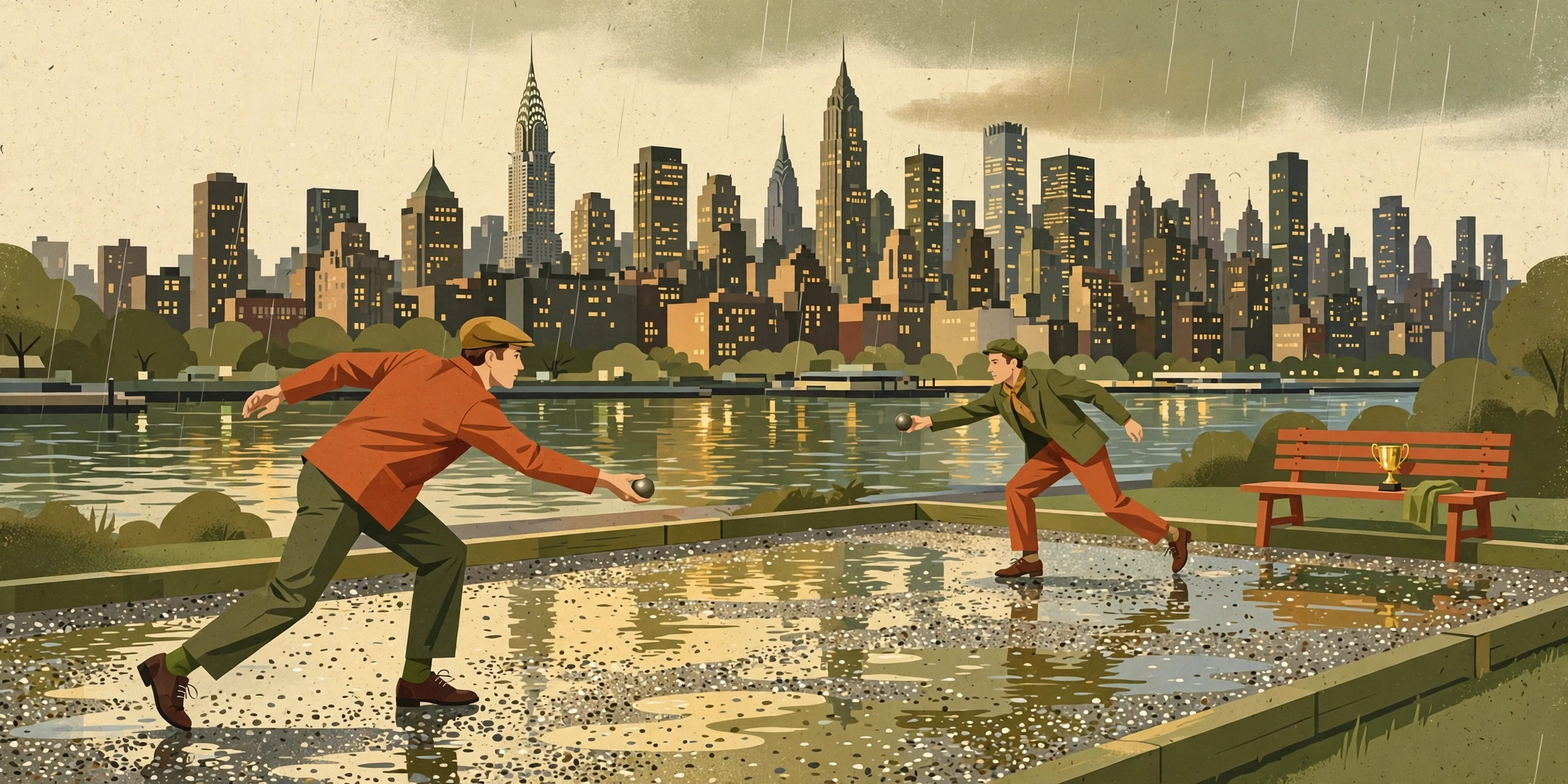
There is a spot in Bryant Park, not far from the carousel, where the lawn gives way to gravel — and where, if you happen through on the right evening, you will find a circle chalked in the dust and a little crowd gathered around it in the particular hush that means something small and serious is at stake. Someone steps into the circle, crouches low, and looses a steel boule that rolls, wobbles, and kisses the cochonnet. The crowd makes the noise crowds make. Behind them, the towers of Midtown stand in the dusk like the world’s most expensive audience.
This is La Boule New Yorkaise, and it is one of the most improbable good ideas in American sport. In the densest city on earth, a French game of village squares and plane trees has taken root on borrowed gravel, and it has no intention of leaving.
Advertisement
The club’s address book reads like a walking tour of Manhattan’s most democratic acres. La Boule New Yorkaise runs free lessons in Bryant Park and Washington Square Park — yes, free, yes, for absolutely anyone who wanders up and asks what the boules are for. Show up empty-handed and curious; leave, inevitably, with gravel dust on your shoes and opinions about pointing versus shooting.
The Friday-night melées are the club’s great social engine. For the uninitiated: a melée is a draw game. Names go in a hat, teams are assembled by chance, and you play alongside strangers who become partners and opponents who become friends. It is the perfect format for New York — a city built on the principle that the stranger next to you might be the most interesting person you’ll meet all week.
The season itself follows the rhythm of the parks: a regular tournament calendar that builds, weekend by weekend, toward the autumn. The club shares its Brooklyn courts with fellow club Local 718 — a small detail that says everything about the ecosystem. In a city where every square meter is fought over, the pétanque clubs of New York cooperate like neighbors in a Provençal village. They keep each other’s courts alive, and the gravel, in turn, keeps them.
There is a particular magic to the crowd that gathers around these games. Half of it is expat French — people who arrived in New York with the game in their blood and were stunned, and then delighted, to find it waiting for them on 42nd Street. The other half is pure New Yorker: joggers who stopped to watch and never left, office workers trading the happy hour for the happy terrain, retirees who discovered that the most French thing in Manhattan is free.
The village square, relocated
Watch long enough and you notice the transplant has taken. The melée behaves exactly like a village draw in the Vaucluse — the banter, the contested points, the ceremonial measuring — except the plane trees have been replaced by skyscrapers and the pastis hour happens under the shadow of office towers. The game does not seem to mind. If anything, pétanque has always been a game about making a square out of whatever ground you have. Manhattan is just ground.
That is the deeper joke of it: pétanque was born to be portable. A circle, a few boules, a cochonnet, and any patch of unpromising earth becomes a theater. The French exported the whole kit a century ago, and everywhere it lands it finds its own skyline. In New York, the kit landed in Bryant Park, and the skyline — well, the skyline does the talking.
The club’s generosity is the other engine. Free lessons are a radical act in a city that charges for breathing room. But the logic is airtight: nobody pays for their first game of pétanque, because nobody survives their first game of pétanque without wanting a second. The boules do the recruiting. The volunteers just hand them over.
And the recruits stay. They stay for the Friday melées, for the tournament Saturdays, for the particular pleasure of a game where a banker and a baker can draw each other as partners and be equals for exactly one evening. The French have a word for this — convivialité — and it turns out to translate perfectly into New York.
October’s climax
Which brings us to the reason the gravel has a little extra charge in its step this week. La Boule New Yorkaise has just opened registration for the US Open of Pétanque, the club’s flagship tournament, set for October 10–11, 2026. Registration is at labouleny.com, and the announcement has gone out like a starting gun.
The Open is the season’s climax — the weekend everything builds toward. Dozens of teams, two days of play, and the particular intensity of a tournament where the regulars know each other’s games down to the millimeter. The Friday melée is democratic; the Open is where the democracy files for office.
There is something wonderfully American about an “Open” of pétanque. In France, the great tournaments carry the weight of a century of tradition. In New York, the Open carries the weight of a city’s ambition — and the city, as usual, shows up. The terrains in the parks will be ringed with spectators who came for the sunshine and stayed for the strategy, and the clack of steel on steel will carry further than usual.
Advertisement
In Provence, the season ends when the light goes. In New York, the season ends with a tournament — same game, new skyline, louder stakes.
If you have never seen a pétanque tournament at this level, the Open is the weekend to fix that. The games are short, the drama is continuous, and the price of admission is exactly what it has always been: nothing. Stand close enough and you will learn the game’s whole grammar in an afternoon — the pointer’s soft hand, the tireur’s theatrical risk, the milieu’s quiet diplomacy.
The format of an Open is part of its charm. Poules in the morning sort the contenders from the casual players; the afternoon’s knockout rounds sort the nerves from the steel. A team can be out by lunch and still spend the afternoon as the loudest supporters on the sideline — because in pétanque, defeat is not an exit, it is a reassignment to the cheering section. The best stories of the weekend are often told beside terrains nobody is playing on anymore.
The new guard
And here is the part that should make the rest of the country’s clubs sit up. LBNY’s players have not just been organizing this season — they have been winning it. At the 2026 national doubles championships, the women’s doubles title went to Kasia Sliz, partnered with Jesse Feldman of Local 718. The men’s doubles title went to Emile Boujeke, partnered with Leo Fleitas of Miami. New York boules, it turns out, travel well.
Sliz, in fact, is having the kind of year players dream about. She and her partner Juanita Celix of Seattle won the Women’s Doubles Qualifier — the victory that decides who wears the Stars and Stripes — and they will represent the United States at the World Championship in Sweden in 2027. From the gravel of Manhattan’s parks to the world stage, in one season. The French would call it a beau parcours. The New Yorkers just call it Friday.
That is the quietly thrilling subplot of the October Open: it is not a farewell to the season so much as a launchpad. The players who light up the weekend will be watched, studied, and — if history is any guide — recruited into the long pipeline that leads from a park circle to a national shirt. The Open crowns a champion; it also introduces the next one.
The club’s relationship with Local 718 deserves its own paragraph, because it is the model of how this sport grows in America. Two clubs, shared courts in Brooklyn, players crossing from one roster to the other — Sliz’s winning partnership paired a New Yorkaise with a Local 718 player, and nobody thought twice about it. In France, club loyalties are inherited and defended. In New York, they are negotiated, shared, and — when the courts demand it — merged. The gravel belongs to whoever rakes it.
France lends, America lends back
There is a version of this story that is all quaintness: adorable French game, charming New York adoption, pass the pastis. But the real story is more interesting. France did not send New York a novelty; it sent a social technology. The melée is a machine for turning strangers into neighbors, and New York — a city of strangers learning to be neighbors — was the perfect laboratory.
And America, for its part, did not just receive the game; it is paying the loan back with interest. The players winning national titles out of the Manhattan parks are proof that the transplant did not merely survive — it is thriving, competing, and now exporting excellence. The World Championship in Sweden in 2027 will feature a team forged, in part, on gravel between skyscrapers. The motherland will be watching. The motherland, one suspects, will approve.
Because that is the thing the French understand, even when they tease: pétanque was never really about the village. It was about the circle. And the circle is the same diameter in Washington Square Park as in a Provençal square — the same chalk line, the same held breath, the same eruption when the boule lands. The scenery changes. The game doesn’t.
And when the last boule of the Open has landed, the season does not quite end. The Friday melées keep their rhythm into the autumn, a little quieter, a little colder, the circle chalked a little closer to the bench. The regulars return because the game is a habit now, not an event. The Open is the season’s exclamation point; the melée is its punctuation. Both are the same sentence: come, throw, belong.
So mark the weekend: October 10–11, 2026. Registration is open at labouleny.com. Whether you go to compete or to spectate — and the smart money says go to spectate at least once, with a coffee, on the Saturday morning — you will be watching the end of one season and, quietly, the beginning of another.
The boules are free. The lessons are free. The gravel is waiting. New York, improbably and entirely, has a pétanque season — and its climax is a week away.