Pickleball
The American Paddle in the French Gym
Pickleball crossed the Atlantic in a tennis bag and landed in the French salle polyvalente: the French Tennis Federation took charge of the sport in January, licensees number in the thousands, and village tennis clubs from Châtillon to Aucamville are converting courts. France is learning the dink — reluctantly, then all at once.
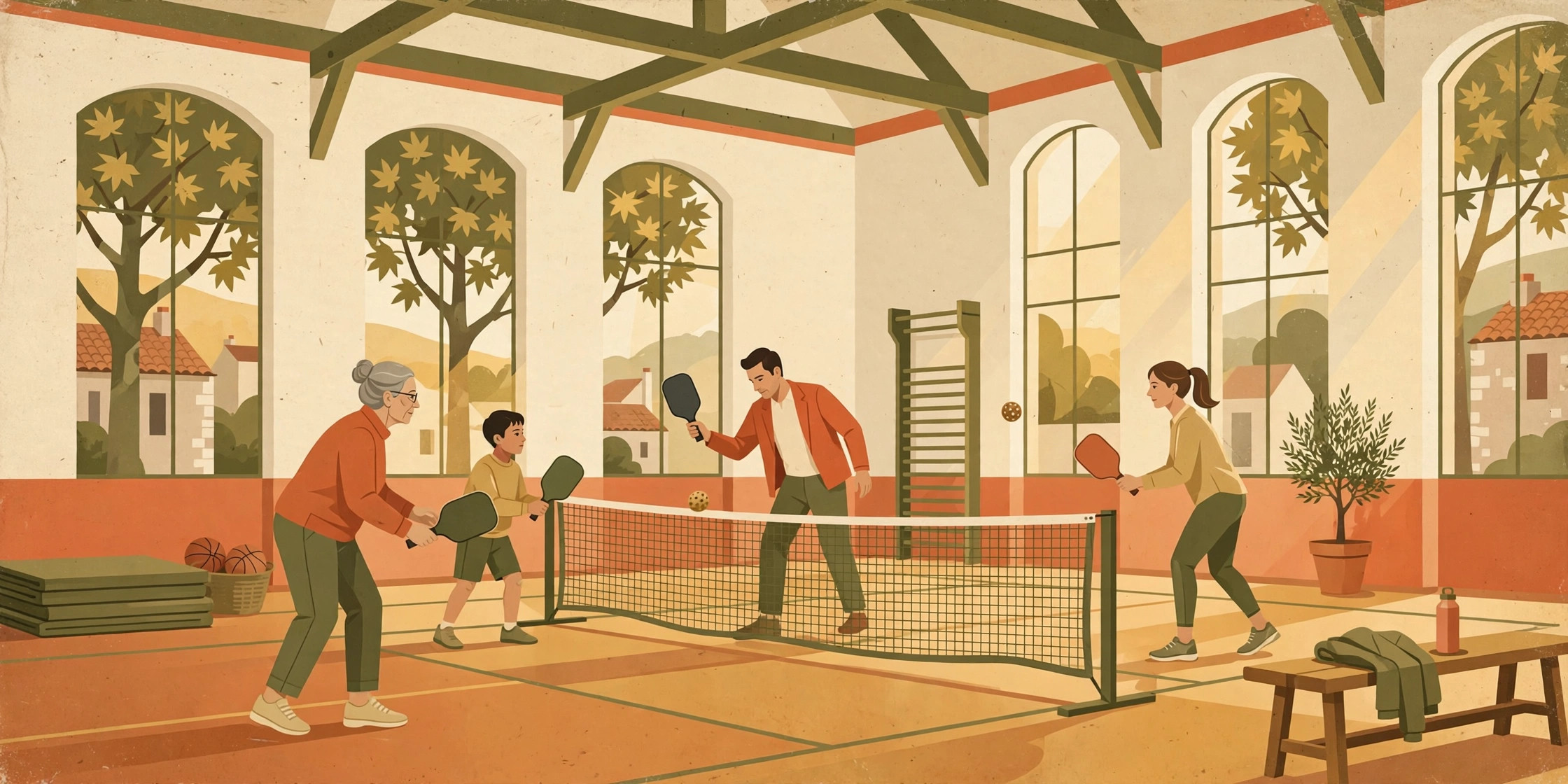
Every Tuesday evening in Châtillon, a suburb south of Paris, the local multipurpose hall fills with a sound that did not exist in France a decade ago: the sharp, hollow pop of a plastic ball off a solid paddle. Around thirty players show up, week after week, from children of eleven to retirees — and the whole thing is run by the town’s tennis club, under a president named Arnaud Balestra who discovered the game on a trip to Guadeloupe and decided, more or less on a whim, that his club needed it. The club created a dedicated pickleball section in 2024. Two years later, the Tuesday session is a fixture, and the club wants to host two official tournaments this season.
Multiply Châtillon by a few hundred and you have the strangest sports story in France this year: pickleball, the most American game invented in the last sixty years — born on Bainbridge Island, Washington, in 1965, out of a bored afternoon and a badminton court — has crossed the Atlantic and is colonizing the French gymnase, one salle polyvalente at a time.
Advertisement
The federation adopts the orphan
The turning point came on January 2 of this year, when the French Tennis Federation announced that the State had entrusted it with the official delegation for pickleball in France. There had been a quiet tug-of-war: both the tennis federation and the badminton federation wanted the sport, which makes a certain sense, since pickleball is essentially their love child — tennis’s net lowered, badminton’s court borrowed, table tennis’s soul. The FFT won, and with its 7,000 clubs, its leagues, and its departmental committees, it announced its intention to “accelerate the development of pickleball throughout the territory.”
At the time, the sport counted roughly 3,500 licensed players in France. That number sounds small until you consider the slope of the curve. Every week brings another tennis club adding pickleball to its offerings, another gymnasium painting the smaller court lines, another municipal sports office announcing introductory sessions. The federation’s embrace did not start the boom — the boom was already underway in the clubhouses — but it gave the boom a letterhead, a rulebook, and a future.
The village clubs, converted
The pattern repeats with the regularity of a drill. Take Aucamville, near Toulouse, where the local tennis club recently held its first internal pickleball tournament — twenty-four players, men’s doubles and mixed doubles brackets, the convivial atmosphere that the French consider a competitive requirement. Ilan Nefnaf and Robin Gabaldon took the men’s doubles title; Elisa Duchemin and Robin Gabaldon won the mixed, giving Gabaldon the rare double. The club has already built two outdoor pickleball courts and can install up to four indoors. This is not dabbling. This is infrastructure.
Or take Baraqueville, in the Aveyron, which made local history this spring by hosting its first officially sanctioned K25 tournament — only the second competition of its kind in the whole department. Open to FFT-licensed players thirteen and up, with women’s and men’s doubles in the morning and mixed doubles in the afternoon, it was the kind of small, serious, well-organized event that is the backbone of French sport. “In a matter of minutes, a beginner can have fun,” the club president explained — a sentence that could serve as pickleball’s entire marketing department.
Or Yvetot, in Normandy, where municipal sports coordinators recently confirmed the discipline’s arrival, framing it as a low-impact, highly accessible alternative meant to diversify local club offerings and draw new demographics into community fitness. Every one of these announcements reads the same way: a town discovers that its gymnasium has room for a court the size of a badminton court, that the equipment costs almost nothing, that the learning curve is measured in minutes, and that the over-sixties — the demographic French tennis clubs have been quietly losing for years — show up in force.
Advertisement
That last point is the quiet engine of the whole phenomenon. Pickleball’s small court means short distances, its light ball means soft impact, its doubles format means constant social rotation. In Saint-Malo, where the Jeanne d’Arc Tennis Club embraced the sport early, players describe matches of about fifteen minutes, partners rotating constantly, strangers becoming regulars within an evening. It is, as one local put it, inherently friendly. The French have a word for the thing pickleball delivers effortlessly: convivialité. It turns out the American game was French-compatible all along. It just needed a smaller court to prove it.
The dink, translated
Here is the part that should interest the pétanque player. Pickleball’s signature shot is the dink — the soft, arcing drop shot that lands just over the net in the non-volley zone, the shot you play when you want to stay in the rally without giving your opponent anything to smash. It is patience made visible. It is, in the vocabulary of this website, a pointer’s shot: placement over power, accumulation over annihilation.
France understands the dink instinctively. This is, after all, the country that invented the point — the careful placement of the boule near the cochonnet — and elevated it to a philosophy. The American game arrives with its thunderclap serves and its overhead smashes, and the French players, being French, immediately gravitate toward the soft game at the net, the patient exchanges, the rallies that look like negotiations. Watch a French pickleball session long enough and you start to see it: the dink treated not as a defensive shot but as an art form. The Americans invented the shot. The French are going to perfect it and then explain to the Americans what they were doing wrong.
The Americans built a game for boredom and called it pickleball. The French are turning it into a discipline and will soon be giving lessons.
There is a delicious irony in the direction of travel. For a century, France has exported its games to America — pétanque to the parks of Manhattan, boules to the gravel of Brooklyn — and America has received them as charming, slightly baffling curiosities. Now the current runs the other way: an American backyard game, invented to amuse children on a summer afternoon, lands in the land of the FFT and gets federated, licensed, sanctioned, and organized into K25 tournaments with morning and afternoon brackets. The Americans made a pastime. The French are making a sport, with paperwork.
What the gymnase knows
The deeper story is about the French sports club itself — that peculiar, wonderful institution, the club omnisports of every town, with its volunteer presidents and its Tuesday-evening sessions and its salle polyvalente that hosts handball on Monday and badminton on Wednesday. These clubs are the capillaries of French athletic life, and they have been searching for years for the thing that would bring in the teenagers and keep the grandparents. Pickleball, arriving from across the Atlantic with its fifteen-minute matches and its instant gratification, turned out to be the answer hiding in plain sight.
The pétanque parallel writes itself. Pétanque is also a game of small courts, cheap equipment, mixed generations, and fifteen-minute social rotations — the melée draw, the apéro afterward, the village square as clubhouse. Pickleball is, in a real sense, pétanque’s American cousin who grew up playing with a paddle instead of a boule. The French clubs adopting it are not betraying their traditions. They are recognizing family.
So the next time you pass a French gymnasium on a Tuesday evening and hear that hollow pop-pop-pop from inside, know what you are hearing: the sound of a mène being played in a new key. The Americans threw the first boule — a plastic one, perforated, across a badminton court in 1965. The French are now pointing theirs right next to it, soft and precise, in the non-volley zone. The dink has come home to the country that invented pointing. Give it five years, and the Americans will be coming to France to learn how to play their own game.